"Half price, I can take it away today, cash on the spot."
The recycler, Mr Huang, gave his number. The owner of the machining plant, Mr Wang, turned to look at his purchasing director. Nine million and change of dead stock, sitting in the corner of the warehouse for close to a year, the labels gone yellow.
The purchasing director was just as wound up. "Prices on this material will come back next year for sure. Selling at half price is breaking the asset's legs. We wait."
One wants the knife, the other wants to wait. They argued all afternoon — and in fact the two of them were not talking about the same thing at all: one was doing arithmetic, the other was betting on the market.
Dead stock has only three exits: clear it cheap, return it to the supplier, or sit on it and wait for a price rise. Don't ask "can I get my original price back" — ask "which road brings the most money back."
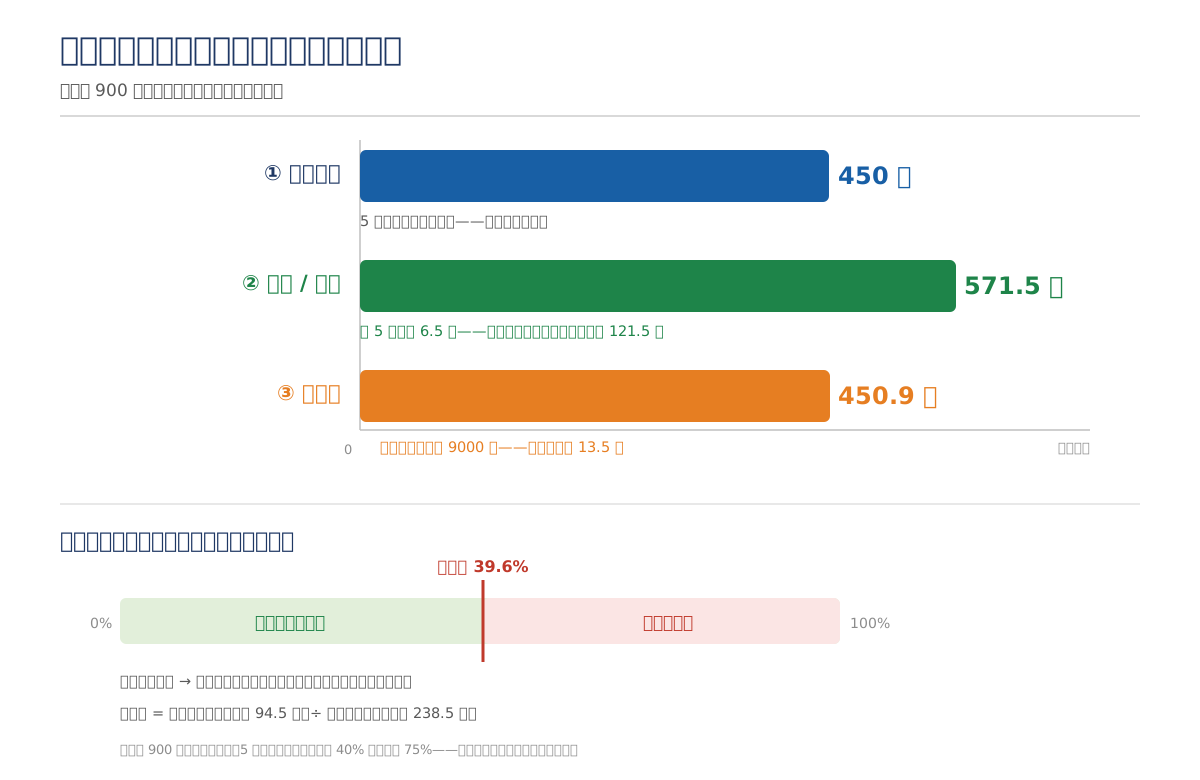
Start with the answer. Take that nine million (half price clears it; waiting six months has a 40% chance of getting back to 75%):
- Clear it now: 4.5 million back. Cash in hand, and the monthly rent stops burning.
- Sit on it: 4.509 million — nine thousand more, six months lost for nothing, and half a year more risk carried for it.
- Return it to the supplier, credited at 65% on the next order: 5.715 million — 1.215 million more than clearing it.
Three roads, and the money back differs by more than 1.2 million. Most people decide without working out a single one of them.
First work out the rent on sitting still — the line everyone forgets.
Dead stock lying in the warehouse costs money every month: capital tied up, warehouse space and handling, and a little value lost each day. Together that is about 1.5% of value per month. On nine million, 135,000 a month; spread across the days, 4,500 yuan burned every morning you open your eyes. Wait six months and it is 810,000 — a year's salary for an engineer, while your material goes on losing value on the rack.
This is not your problem alone. When semiconductors ran short a couple of years ago the whole industry piled material into warehouses, and it took a year and a half to clear. Their way of counting inventory is worth learning: they do not count money, they count months of supply. Microchip went into the end of 2024 with nearly nine months of stock, down to half a year by June. STMicroelectronics went from five and a half months to four. Texas Instruments is still sitting on seven months. The biggest chip makers in the world, with channels and pricing power, still measure clearing in years — what makes you think your nine million turns around in six months?
The second road: return it to the supplier — the one most people forget.
Everyone's first reaction is "dead stock can only be dumped cheap". But the supplier still has cards to play: take the whole batch back, swap it for material you still use, or credit it against the next delivery. The key is to talk early. Within two or three months of delivery is best. After half a year the supplier has long since booked the money as revenue, and taking it back means taking a loss — you will get nowhere.
One LED company did it more cleverly. On a batch of driver power supplies that would not sell, engineering found the core chip was shared with a new model. Swap one peripheral capacitor, go back to the supplier, modify it — and they sold it at 75% of the new-model price, twenty-five points better than clearing at half price.
So should you wait? Exactly one number decides it: forty percent.
If you are betting this material rises in six months, how much confidence do you need before the bet is worth taking? In this setup the answer is forty percent. No forty percent, no bet — sitting on it is not an investment, it is buying a lottery ticket with 810,000 in rent.
And there are three kinds of material that must be cleared at once, even when the arithmetic says waiting is better. These are not a price problem. They are money that will never come back.
1. Material dedicated to one customer, when the customer is gone or the model has stopped. A pharmaceutical ingredient maker's only customer blew up; its dedicated intermediate passed the re-test date; net realisable value went to zero and the whole lot was written off (East Asia Pharmaceutical, 2025 annual report inquiry response). 2. Material displaced by a new technology. The obsolete parts of an old model will not come back to the original design in three years either (Ronglian Technology, 2025 annual report: long shelf age, outdated technology, not saleable). 3. Material with a shelf life, a re-test date or a certification date. The calendar does not negotiate on price.
Is "prices will come back next year" a reliable sentence? Some bets do win. Tianyuan Group caught a PVC rally in the first half of this year and sold its inventory out, actually reversing 24.41 million of provision (announcement, July 2026) — note, it sold when the window opened, it did not wait forever. More people lose. After a sharp spike in tungsten raw material, prices fell back fast and Zhangyuan Tungsten provided 225 million against inventory in the first half (announcement, August 2026). Car sales missed plan, GAC Trumpchi and Aion let inventory pile up passively, and provisions rose sharply (SSE inquiry response). Wanxiang De'nong provided 5.61 million against a seed inventory (announcement, April 2026). The winners file announcements. So do the losers.
On definitions: the monthly rent is taken at 1.5% — capital tied up, storage and depreciation, a common mid-range figure. Use your own finance department's number. The nine-million case is desensitised.
Back to your warehouse, in three steps. First, pull an aging report (how to do it is in the previous post). Second, tag every item — dedicated, general, or time-limited. Third, run the three roads on the general material and send the dedicated material straight to the disposal list. Do not let "let's wait a bit" become the most expensive three words in your warehouse.
Clearing dead stock is not admitting defeat. It is turning tuition back into cash.
Next, on how to choose suppliers — why a scorecard always ends up picking the one with the best relationship rather than the one who does the best work.