"Add another 500 of safety stock. Just to be safe."
One word from the boss and purchasing and planning are at it again: one says 800 is enough, the other will not be covered without 2,000. Two hours of argument, nobody convinced.
Because the two of them are arguing about the same wrong question: how much to hold.
The question they should be asking is — who is this stock defending against?
The answer up front: most of the "just in case" stock in your warehouse is not guarding you against customers. It is guarding you against suppliers.
And most people get the stance wrong too. Chasing a supplier to be fast does almost nothing. Chasing him to be steady — arriving the day he said he would — works immediately.
On the same material, cutting lead time from 20 days to 10 cuts safety stock by 1.7%. Halving the swing in that lead time cuts it by 45%.
Why? Look at this formula — don't be scared, it is three things once you open it up:
Safety stock = service factor × √( average lead time × demand variance² + average daily demand² × lead-time variance² )
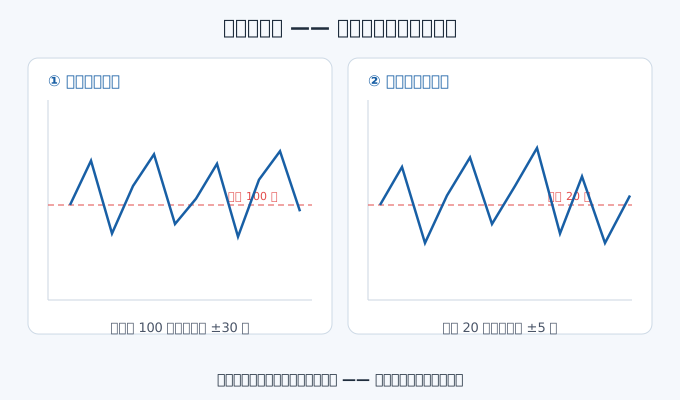
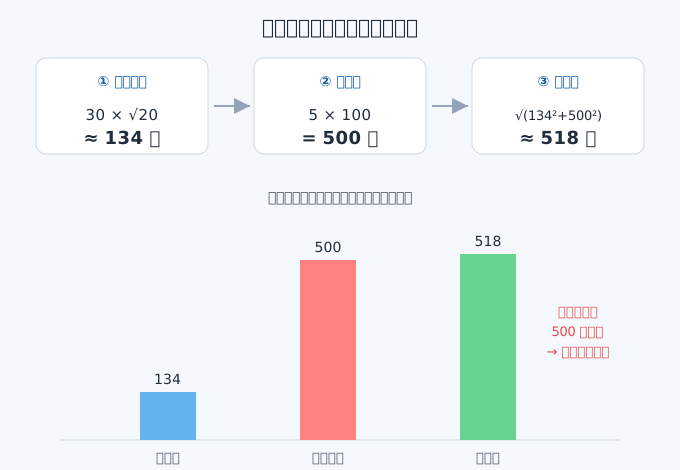
1. The first term guards against the customer buying more or less than expected across those 20 days of waiting. 2. The second term guards against the supplier being late. Every extra day the lead time drifts is another day's worth of sales you have to hold. Note that average daily demand enters squared — the more you use, the more frightening this term gets the moment lead time drifts. 3. How the two combine: not by adding, but by the hypotenuse — 3 metres north and 4 metres east puts you 5 metres from the start, not 7 (the two swings are random in direction and partly cancel each other). Then multiply by the service factor (1.65 if you want a 95% chance of not stocking out). Put numbers in (100 pieces a day, demand swinging ±30, lead time 20 days, lead time swinging ±5). The customer's swing contributes 134 pieces; the supplier's contributes 500. The same amount of swing — and the supplier term is nearly four times the customer term.
This is not a paper exercise. The component market of 2025 is the living textbook.
One SRAM part sat steadily at 2–8 weeks for years. From the first half of 2025 it began to drift, and by Q4 many part numbers were out past 16 weeks — from "stable" to "anybody's guess". Memory was worse. DRAM lead times doubled; DDR4 and DDR5 were quoted at 26–40 weeks and beyond (Avnet Silica quarterly lead-time reports / Sourceability Q4 2025 lead-time report).
Read the formula and it is obvious. When a lead time goes from steady to drifting, σ_L rises and that whole term — average daily demand² × σ_L² — rises with it. The same part, with an unreliable lead time, needs a visibly bigger buffer. That is why, that year, purchasing departments across the industry were all doing the same thing: either add inventory and lock capacity, or watch the line get dragged to a stop.
Here is the counter-intuitive point. Lead time getting longer and lead time getting unstable are two different things. Longer — 6 weeks to 10 weeks — gets announced, gets discussed, and you naturally order earlier. It raises your normal stock level, and it is planned money.
Unstable — 6 weeks, then 16, then 6 — is different. Nobody tells you. And what it raises is exactly the buffer you are holding for nothing. That term is multiplied by the square of daily demand, so it grows fast. Watching how long lead times are is not enough. What you really need to measure is how steady they are. Measure it early and you can still lock volume and line up alternates; wait until nobody can get anything and it is too late.
So back to your warehouse. If that pile of stock is defending against supplier lead time, what you need is not "hold a bit more". It is this:
1. Ask the supplier a different question: "What is the latest you would deliver?" 2. Write down every actual arrival date and work out the standard deviation of his lead time. 3. That number is the size of the money you are holding for nothing. Take it into the negotiation — it is a commercial term, not a complaint.
Safety stock is not "a bit more insurance". It is deciding whose variability you carry. Manage the supplier's swing and the inventory comes down by itself.
Thirty-second self-test: is your safety stock a number someone guessed, or a number someone calculated? Ask your supplier "what is the latest you would deliver", then look at the pile in the warehouse — most likely, you are covering for him.
Next, on inventory turnover — why cutting order quantities the moment turnover looks slow is usually the wrong cut. Slow turnover has three causes, and three different medicines.