What is November 10?
In October 2025 China and the United States reached an arrangement in Kuala Lumpur: the US 24% reciprocal tariffs, China's countermeasures and both sides' export controls were suspended together until November 10, 2026 — fifty-six days from today.
Suspended. Not cancelled.
After the announcement in April 2025, neodymium-iron-boron permanent magnet material containing dysprosium or terbium went onto the control list: magnets, magnetic rings, magnetic blocks, all of it — but once it is made into a motor or a speaker, it is not on it.
The same material, cut at a different step, is or is not controlled.
Do not look at the price yet. What breaks first this round is not the money. It is whether there is any.
In May 2025 Ford stopped the Explorer line at its Chicago plant for a week. Not for want of chips — for want of magnets.
The harshest number is in India. Maruti Suzuki had planned 26,500 new battery-electric vehicles between April and September and built 8,200. Bajaj built 10,824 electric scooters in July against 20,384 a year earlier — down 47%.
Over that stretch, Indian firms filed close to thirty import applications. Not one was approved, and not one shipment arrived.
Magnets are under 5% of a vehicle's cost. The cheapest part is the one that can stop the most expensive line.
My first thought was simple: take it apart and see where the cost is.
Taking it apart is when I learned that magnetic steel is not a lump of iron. It is several rare earths mixed in proportion — praseodymium-neodymium as the base, dysprosium and terbium as the "additives", the amount depending on the temperature grade you need. The industry calls this "should cost": not what the supplier quotes, but what it should be.
But I built it to see the cost, not to beat the price down.
Here is the thing most people do not know: what decides how much dysprosium and terbium go in is not the number in the grade — it is the two letters after it.
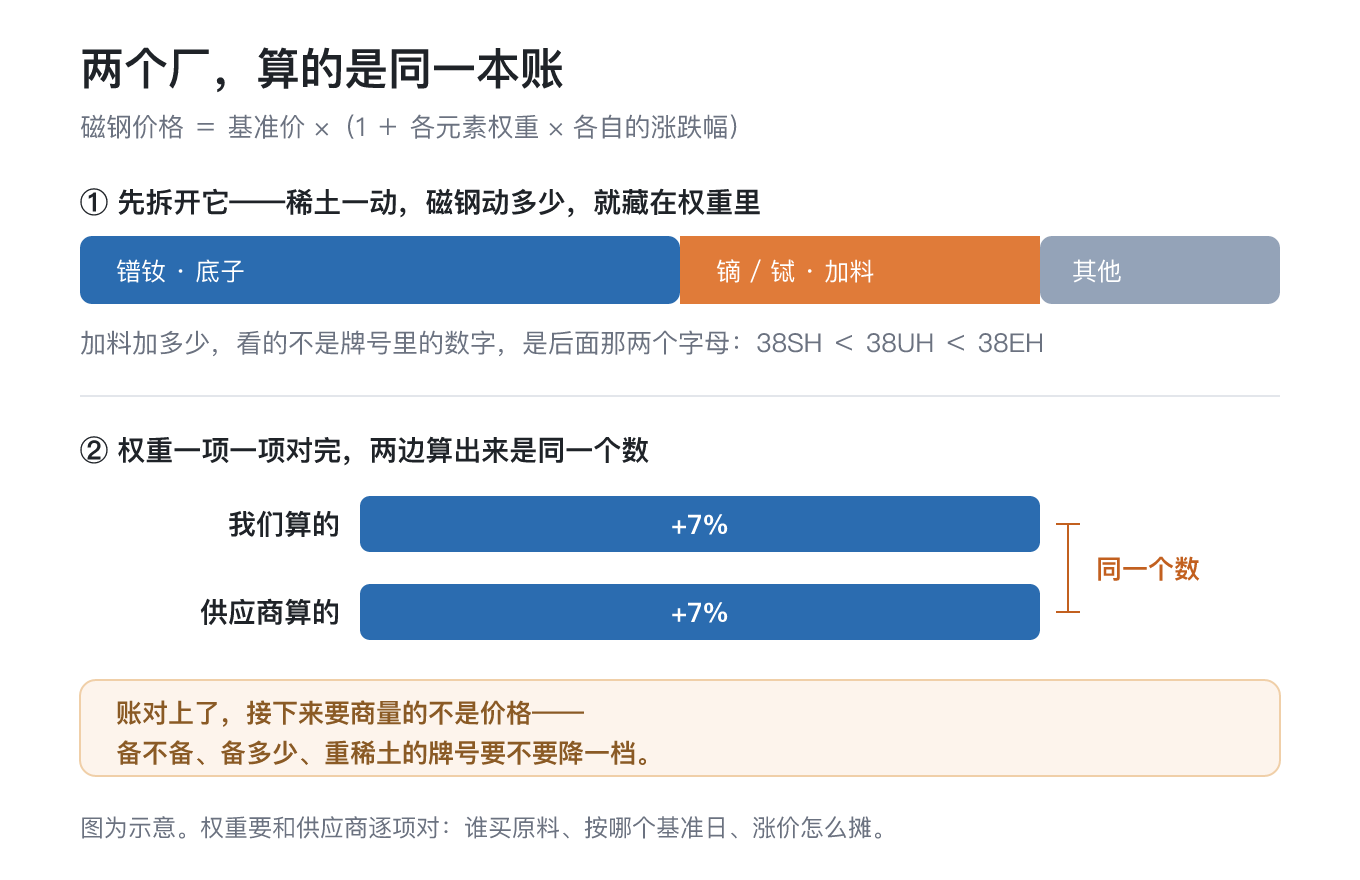
38SH, 38UH, 38EH: the number in front is the magnetic performance; the letters behind are the temperature grade. SH uses little dysprosium, UH needs more, EH more still — the same magnetic performance, a different letter, and the heavy-rare-earth content can differ by more than double. And the customer specifies the letter.
So it can be calculated: magnet price = base price × (1 + each element's weighting × that element's price move).
The hard part is not the formula, it is the weightings: who bought the raw material, against which base date, how the increase is spread. Those three cannot be worked out behind closed doors. You have to sit at one table and go through them item by item.
So I pulled the supplier in and we built the sheet together. When it was done, both plants held the same set of books: rare earths move one notch, and both sides compute the same change in that magnet's cost.
That is what it is really for. Once the market takes off, both sides read the same book — whether to stock ahead, by how much, whether to drop the heavy-rare-earth grade down a step — and only then is there something to discuss. Otherwise each side keeps its own accounts, and the two of you have nothing to say to each other.
But it can only calculate as far as "if".
I asked the supplier to his face: can you give me a price-lock window? Their raw material is bought in the month and costed in the month too. They do not know their own cost next month. How would they dare to promise? He was not dodging. He genuinely did not know.
In the first half of 2026, praseodymium-neodymium oxide rose 73.6% year on year. Did the people inside the chain get it right that year?
No. Even the magnet makers were losing money.
Youyan New Material, which makes rare earth materials and magnets, posted a net loss of 31.49 million yuan in its rare earth segment in the first half of 2026 — raw material up seventy percent, and the magnet maker in the red. The increase did not travel down the chain.
Downstream was the same. Japanese automotive-industry statistics: rare earth procurement costs rose 22.3%, and only about 4% of companies could pass the cost on to customers in full.
I can work out how much the cost should rise. Whether it passes through, I cannot.
If even the magnet makers could not pass it through, what makes you think that you, sitting outside the chain, can get it right?
There is one more thing I did badly that year.
We took an order. The selling price was agreed, and the magnet price was not locked ahead. Raw material climbed and climbed, and by the time delivery came near, the cost was over the price we had agreed. That order did not end up being executed as written.
The problem was not "whether to lock". I built the sheet; both sides accepted the numbers. But we had only got the numbers clear. Nobody had agreed: at what point, who does what.
Having a clear set of numbers is not the same as having a plan.
So what do you actually do?
In the 2010 round the policy was out in the open — that July the export quota was cut by close to forty percent in one go. I could see it at the time.
But seeing the hand that pushes does not tell you how hard or how long it will push next. This round it is wearing different clothes, and it is still policy.
Supply and demand can be modelled. Policy can only be waited out. And "waiting" does not appear on any sheet.
So I split the uncertainty in my hands into two piles.
The first pile can be calculated: cost breakdown, historical volatility, the supply-demand gap — give it a range, work out an expected value.
The second pile cannot: whether policy changes, whether the list grows, whether November 10 is extended or left to lapse. These have no distribution and no frequency, and I do not guess at probabilities.
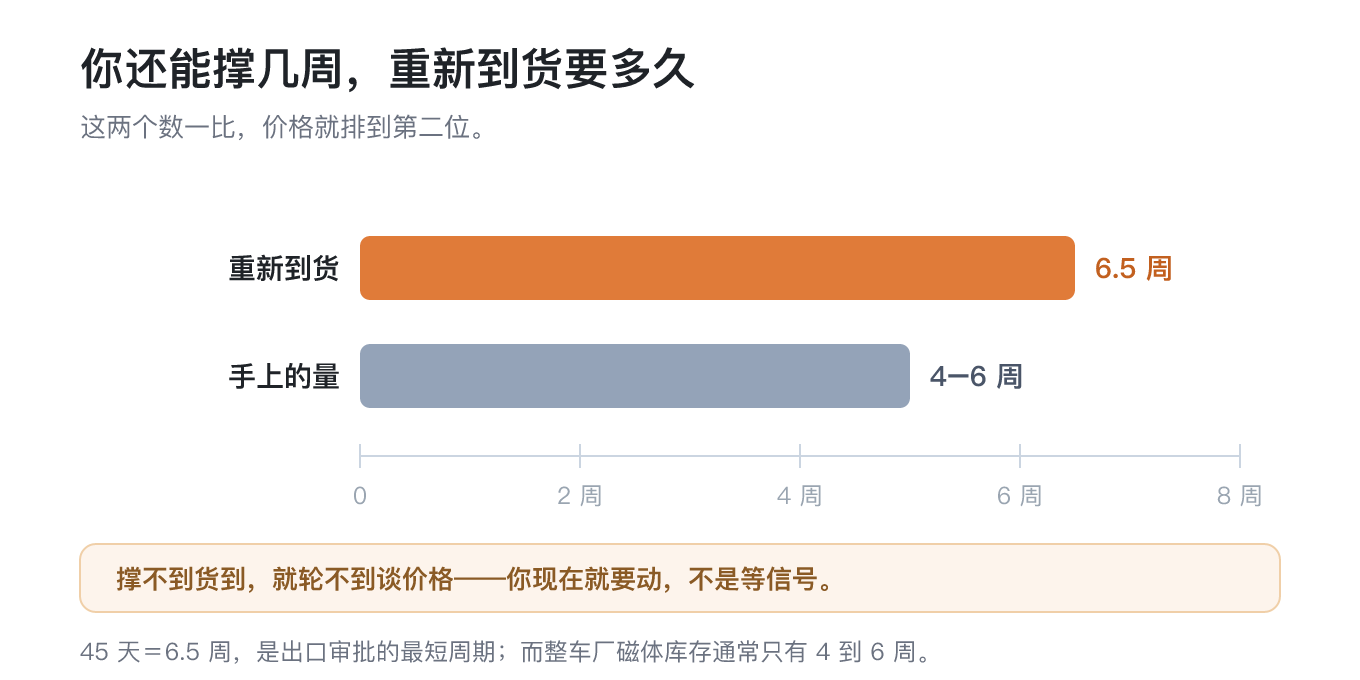
But there is one thing you can work out on the spot: how many weeks your current stock covers, and how long it takes to get more.
Export approval takes at least 45 days, six and a half weeks. A carmaker's magnet inventory is only 4 to 6 weeks. The moment the weeks you can cover fall short of the time to restock, price stops mattering — you are not waiting for a price cut, you are already too late.
Because inventing a probability is more dangerous than giving none — the moment a number appears, everyone decides on it: material that should have been stocked is not, prices that should have been negotiated are not, margin that should have been kept is not.
Back to the question at the start: after November 10, will you still be able to buy your rare earth magnets?
My answer is still the same sentence: nobody can guarantee it to you — your supplier included.
So what you can do now is not to go looking for another answer, but to write the answer down in advance as a line — at this point, I act.
And that line has to be on paper, not just in your head. The moment the market moves, the first thought that surfaces is always "will it come back down". By the time you have thought it through, the lead time is gone.
I have put it together as one card. First fill in how many weeks your stock covers and how long restocking takes — "is there time" jumps out on its own. Below that, three columns: up, flat, down. Under each, write it plainly: at what condition, who does what, on which day.
It cannot give you the right answer. Its use is that at the moment things happen, you do not have to decide on the spot.
Twenty-four years in, I have stepped in plenty of pits ahead of you, and filled in the ones I could — and left the tools behind.
Whether to hold material or lock a price was never the question. The question is whether you actually know what you are betting on.