To save 5,666 yuan I ordered seven boats' worth of extra material
(What you save is a one-off. What you tie up is a pile of goods that bills you every month.)
In 2008 I ran purchasing at a catamaran builder. Around a hundred boats a year, two models at 37 and 38 feet, sail and engine.
One day a supplier sent a fibreglass quote with four tiers:
| Tier | Minimum at one time | Unit price |
|---|---|---|
| One | 1–4,999 kg | ¥8.00/kg |
| Two | 5,000–14,999 kg | ¥7.60/kg |
| Three | 15,000–29,999 kg | ¥7.20/kg |
| Four | 30,000 kg and up | ¥6.90/kg |
That time we were ordering material for twelve boats. One boat takes 1,574 kg of fibreglass; twelve is 18,888 kg — right inside tier three.
I chose tier four.
I saved 5,666 yuan. The price was ordering material for seven extra boats.
Going back over that arithmetic today, I finally saw it: at the time I worked out only what I saved. I never worked out what the extra stock costs me every month.
First, spread the quote out
Hold on to one number: what I actually needed was 18,888 kg. Fix that number, or everything after it is idle.
| Tier | Unit price | Saving on the tier below | Extra you must buy | What it costs you |
|---|---|---|---|---|
| One | ¥8.00 | — | — | Out of reach: your volume is already over its ceiling |
| Two | ¥7.60 | 0.40/kg | — | Out of reach: same reason |
| Three | ¥7.20 | 0.40/kg | None | Stop here. Your volume lands in it |
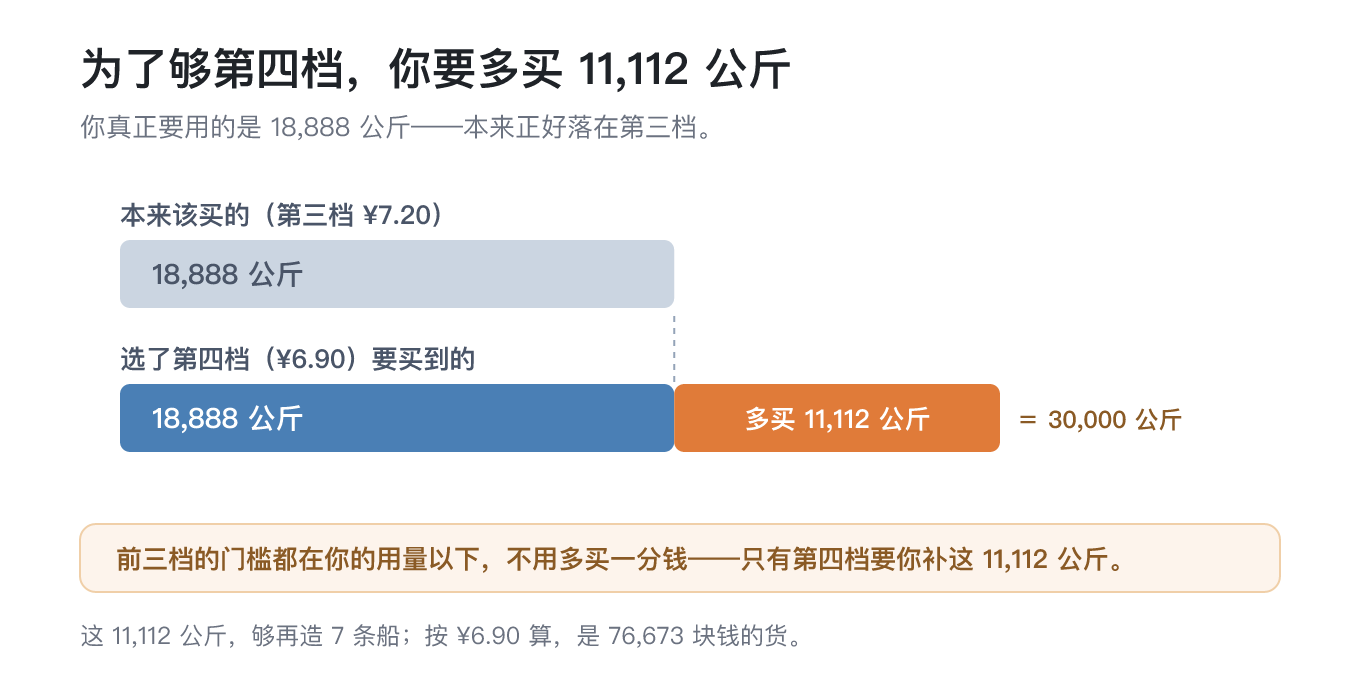
| Four | ¥6.90 | 0.30/kg | 11,112 kg more | 76,673 yuan of extra stock |
The first three tiers cost you not one yuan of extra material; the discount is free — your volume already clears their thresholds.
Only tier four is bought with real money.
What you buy is 0.30 yuan a kilogram off, which on the 18,888 kg you actually need is 5,666.
What it costs is closing the gap to the 30,000 kg threshold: 11,112 kg more, enough to build seven more boats. At ¥6.90 that is 76,673 yuan of goods.
5,666 saved, against 76,673 tied up.
What that extra stock actually costs you
First, be clear: it is not 76,673. The money is not lost. The goods are still in the warehouse.
What costs you money is every day they sit there. Goods in a warehouse eat twenty to thirty percent of their value over a year: the capital is stuck and earns nothing, the warehouse needs space, needs people, suffers damage, and carries the risk of a price fall. The customary estimate in this trade is twenty-five percent a year, about 2% a month.
| The extra stock | Number |
|---|---|
| Value (the money is stuck here; the goods are still there) | 76,673 yuan |
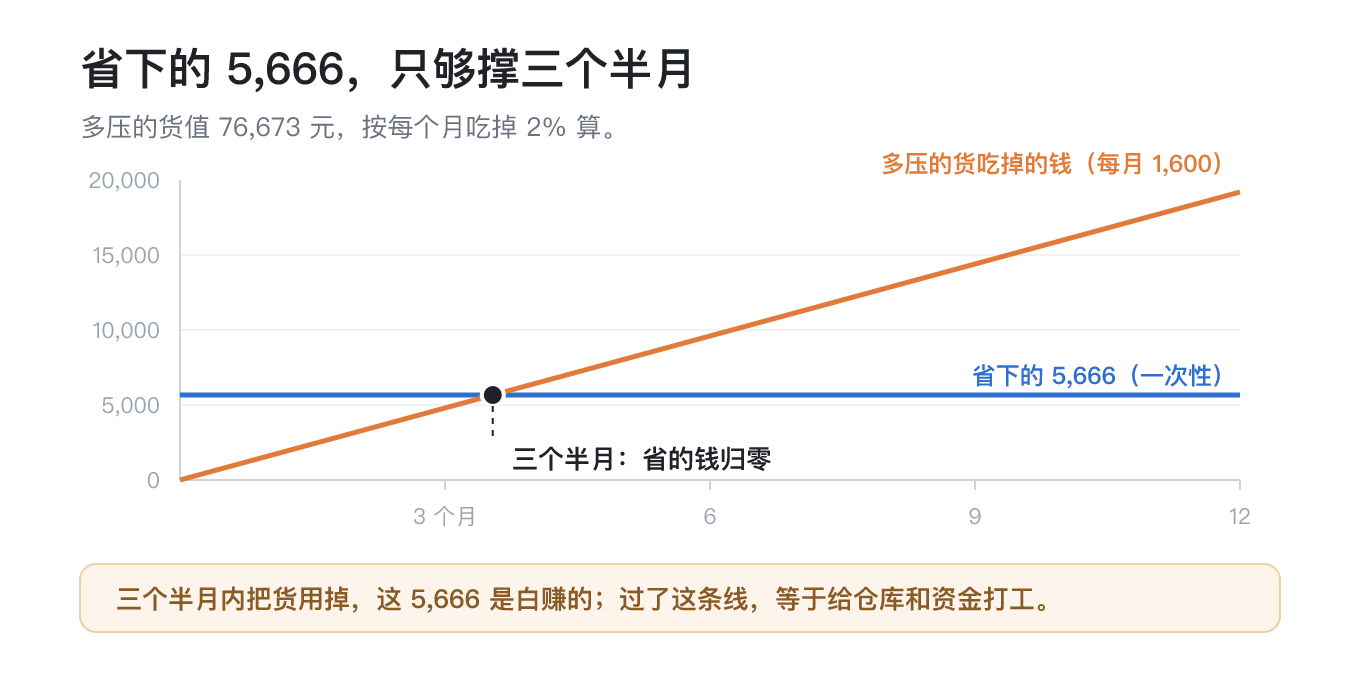
| Carrying cost per month, about 2% | about 1,600 yuan |
| Over a year, at twenty-five percent | about 19,200 yuan |
| How long your 5,666 saving covers it | three and a half months |
The 5,666 you saved is a one-off. The extra stock is a deduction every single month.
Three and a half months, and the saving is back to zero.
So whether it pays comes down to one word: fast
If that material gets used inside three and a half months, the 5,666 is free money and you should take the tier.
If it does not, you are working for the warehouse and the financier — paying the saving back, month by month.
Whether "better price for bigger volume" pays was never about how many points he knocked off. It is about how fast you consume the extra you ordered. Not "volume is always good", not "volume is always a trap" — your consumption rate decides.
Why this arithmetic is easy to miss
The 5,666 you saved is booked to purchasing's account, and it looks good this year.
The 76,673 you tied up is booked to inventory's account, and it grows every month after.
Two amounts land in two people's books, and whoever opens his own book does not see that he did anything wrong.
That pit is hard to fill — not because nobody calculates, but because nobody puts the two books side by side.
(The tiers, unit prices and volumes on this quote are reconstructed from the market at the time and the records of comparable hulls. It is not the original document. The arithmetic is real.)
So the next time you meet a tiered price, do not look at the unit price first. Do three things.
One: fix the volume you will use. Not how much he wants you to buy — how much you genuinely need.
Two: run your own volume against the discount and see what you save.
Three: work out how many months it takes to consume the extra. Past three and a half months, do not take that tier.
One quote, one volume figure, and you can check it on the spot. No model needed.
Twenty-four years in, I have stepped in plenty of pits ahead of you. We fill in as many as we can.