A young woman was going on her honeymoon.
The traffic was bad. By the time she reached the airport, the gate door was already closed.
The ground staff stopped her. No. The rules are the rules.
Most people, at that point, would do one of three things: argue with the ground staff, explain over and over how urgent it was, or simply give up.
She did none of them.
She did not argue, she did not make a scene, she did not beg. She just turned and looked at the captain standing not far away — the only person at that whole gate with the authority to reopen the door. And she looked at him with pleading eyes.
The captain opened the door.
She caught her honeymoon.
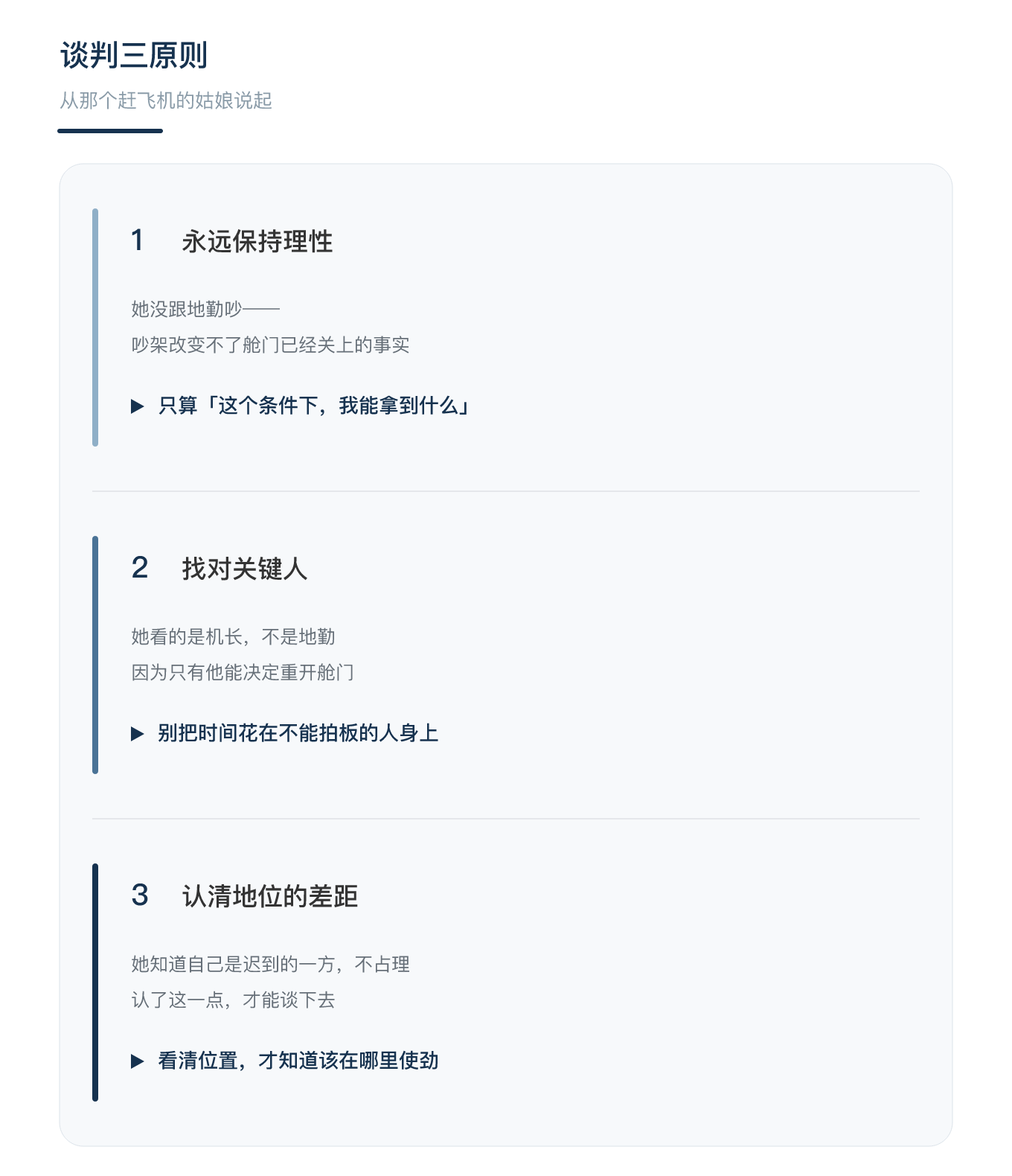
I have kept that story for years. It is the most powerful commentary I know on the three principles of negotiation.
Most people think negotiation is the art of language.
That young woman did not say a word from beginning to end, and she completed the most textbook negotiation of all.
Sometimes negotiation does not need language at all.
These three principles I worked out one by one, in a purchasing category that was entirely unfamiliar to me at the time.
First, my situation.
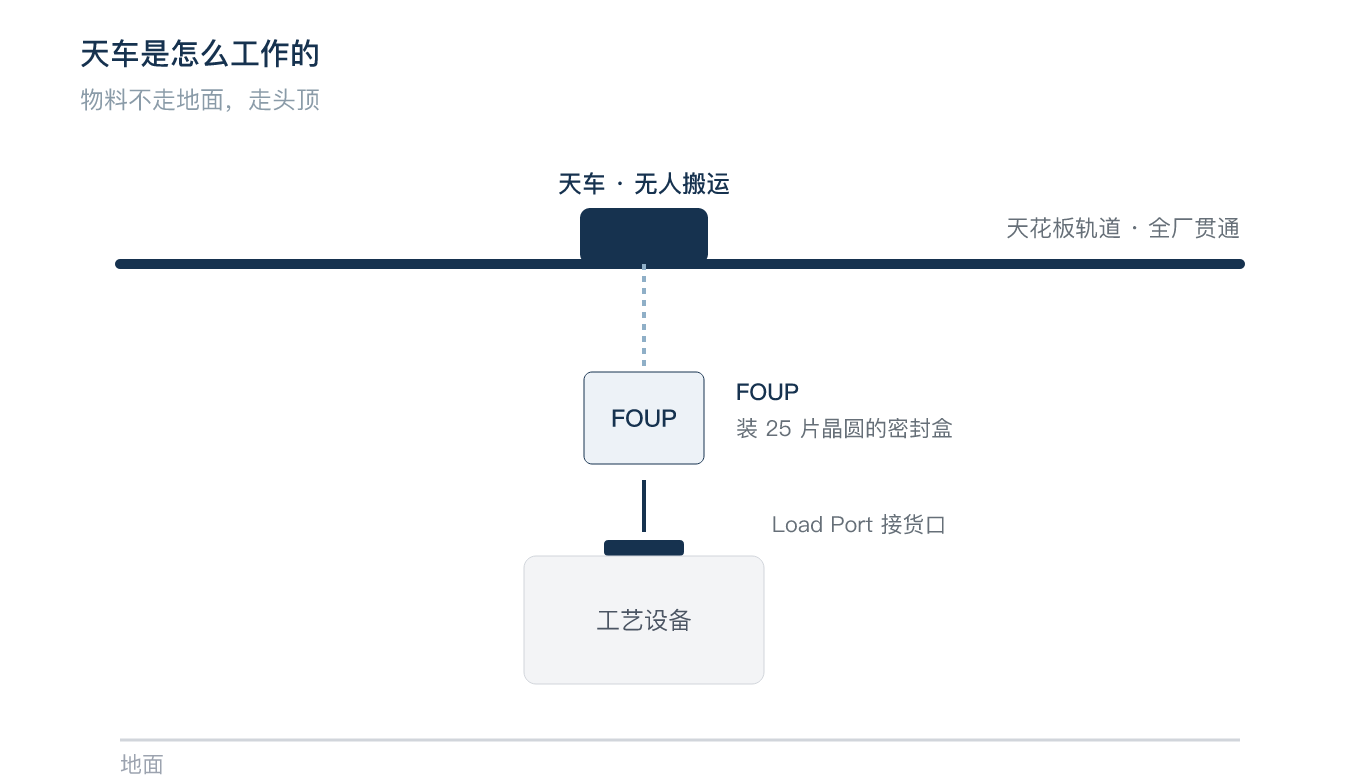
Our company made semiconductor wafers. The line we had was 8-inch — no overhead hoist needed. Wafer pods were light and the move frequency was low; people could carry them.
On the new 12-inch line, a full pod weighs 9 kilograms and the move frequency doubles. This was not a question of whether we wanted to. People physically could not do it.
So the new 12-inch fab had to have a full automated material handling system. And it was not bought in one go. The line ramps in stages: get the pilot line running, hold it, then step up level by level, and the hoists are bought in batches matched to each phase's capacity.
I was assigned to buy it.
The technical specification landed on my desk. I opened the first page: Stocker, Tower, OHT, FOUP... I knew every letter, and strung together they meant nothing to me.
I had never even seen what the thing looked like.
And the going rate in that business: the hoist system for one 12-inch line runs 1.5 to 2 billion yuan.
Worse: only two companies in the world could supply it.
I had to take a specification I could not read and negotiate a price with them.
One — stay rational
Rationality is, at bottom, being honest about the facts: knowing what you know, and knowing what you do not.
Elsewhere that is a platitude. At a negotiating table it is the hardest thing to hold on to. Once a person does not understand something, there are usually only two reactions left: bluff, for fear of being looked down on; or abandon judgement altogether and take whatever the other side says as given. The second is more dangerous. He says this configuration is standard and you believe him. He says this price is the industry norm and you believe that too — every sentence sounds reasonable, because it is his expertise, not yours.
Being honest means admitting where the boundary is. The parts you do not understand, do not fake and do not guess at, and do not treat as settled just because the other side said it with confidence. How to configure the solution, whether the parameters are enough — those are professional judgements and belong to professionals. The company had an AMHS department; they understood it better than I did, so I listened to them. Insisting on competing with them is taking your weak hand against their strong one.
But the part that was mine to judge could not be handed away. Money, timing, terms — which one can be conceded and how far, when to push and when to wait — that is my expertise. It has nothing to do with technology and everything to do with position.
Rationality is making the judgement inside your own expertise, and taking the judgement inside someone else's.
Applied to that purchase it comes down to one sentence: look at where the two sides' priorities are mismatched. What I want most and what he wants most are not necessarily the same thing — so trade my low priority for his high priority. The mismatch is where the win-win is.
Two — find the person who decides
Do not spend your time on people who cannot say yes.
That Japanese company's China branch handled after-sales and installation support. The people who could actually set terms were at the other end, in Japan — so our counterparty was never the local branch to begin with. Across the table sat their salespeople, their capacity planning department, and senior management.
Whoever you need, go straight to them.
Three — see the gap in position clearly
This one sounds the most defeatist and is in fact the most useful. But what I mean is not resignation — it is seeing clearly where you stand first.
In those years both hoist makers were under extreme capacity pressure, and on top of that came the pandemic, and lead times were pushed out again and again. By ordinary logic, when demand exceeds supply the seller has no reason to concede. So how did we get terms?
Because we held something. Three things.
First, ninety percent of the world's share was split between two companies. Two companies means competition. Your leverage is not "a third supplier". It is "the other one".
Second, Chinese semiconductors were growing fast then, with a wave of 12-inch fabs coming on stream. To those two Japanese firms, China was the growth market they were fighting over — and we were part of that market.
Someone will ask: was domestic equipment not catching up? It was, genuinely. But we were building a mature-node line, under a hard schedule, with high yield requirements. That is no time to run a validation on domestic equipment — there was not the time, and there was not the risk appetite. So the choice at that moment was those two.
Third, and most important: we were expanding continuously, and we were willing to show them the plan. How much the next phase would take, how much more would come after — we did not hide it. To a supplier who means to serve this customer for the long term, that is a large and certain cake.
Someone will say: if you cannot switch suppliers, what kind of leverage is that? True, we could not switch. Once the selection was made, changing mid-project meant revalidation and re-commissioning, and the line could not wait. But look at it from the other side: he knows how much volume is coming, and that volume is only reachable by staying in.
That is not a threat. It is a temptation. And for us, since we could not switch, "walking on together" was the only negotiating language available — and the best one.
Get those three clear and the aim of the negotiation becomes clear: do not grind away at any single item. Spend the money where it is worth most — lead time, service terms, long-term cooperation — and concede none of them.
Seeing your position clearly is not for giving up. It is for knowing where to push, and for finding the position where both sides can walk on.
The result
Price, lead time and service terms — we got good conditions on all of them.
That result was not luck. Many people think that facing a supplier stronger than you, holding your ground is already an achievement. But unequal position does not mean you have no cards. It means you have to go and find them.
Back to the girl who caught her flight. The captain opened the door in the end not because she was pitiable, but because in the worst position she still did the three things right: stayed rational, found the person who decides, and saw the gap in position.
None of the three is new.
The hard part is doing them, one by one, at the moment the door has already closed.
Twenty-four years in, I have stepped in plenty of pits ahead of you. We fill in as many as we can.