I dug out an old sheet recently. From a yard I worked with back then — a builder of catamarans for export. Across the top, one cell per day, from December into the following July. Down the side, the boats, a dozen or more under construction at once.
This post chases one thing only: how that delivery date was worked out, step by step. And for every step I will first lay a foundation with the renovation work at your own home.
1. The life of one boat
Look at how far it has to travel first, or you will not know what the sheet is scheduling.
| Stage | Where | What happens | What it is hostage to |
|---|---|---|---|
| Lay-up and moulding | Yard workshop | Fibreglass cloth and resin laid up into a hull | Cure time, set by physics |
| Outfitting | Yard workshop | Pipework, wiring, cabins, furniture | The two crews doing the work |
| Inspection | Yard | Checked item by item | The widest variability in the whole run |
| Launch | Into the Fuchun River | Down the slipway | Tide — it does not launch when you feel like it |
| Passage | Fuchun River → Qiantang River → Zhoushan | The boat sails herself there | Days unsuitable for moving hulls |
| Stepping the mast, sea trials | Zhoushan | The big items go on only at sea | Weather |
| Customs clearance | Zhoushan | Customs release | Customs |
| Delivery | Zhoushan | The buyer sails her away | — |
The delivery date in the contract falls on the last row. Not "finished building" — "handed over". Between the two lie a yard, two rivers and a customs post, and if any stretch jams, it is a breach.
2. Break the boat into pieces of work (tasks, in Project)
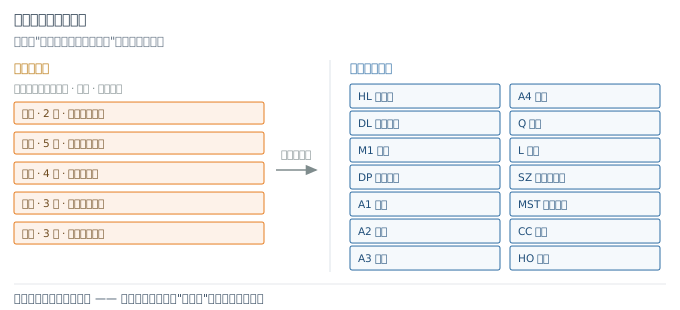
Before a renovation starts, the foreman writes a list: knock down walls, plumbing and electrics, tiling, carpentry, painting. A decent list spells out three things for each item: who does it, how many days, and what "done" looks like. Anything that cannot be written that way — one line reading "plumbing and electrics" covering two months — will sit at "half finished" forever.
The boat sheet starts the same way. Every piece of work carries a code, and a row of codes read in sequence is the life of that boat.
3. Who has to wait for whom (predecessors, in Project)
Sequence in renovation comes in two kinds. One is set by the process: the levelling compound has not cured, so the floor cannot go down. The other is set by people: the contractor is fitting out several flats at once, and the plumber finishes at this one and moves to that one — those men are never waiting on any particular flat.
The boat sheet draws both. Look at a single boat and the order is fixed: with no hull formed, nothing inside can go in. But schedule a dozen boats together and the hull crew and the outfitting crew are two different sets of people with two different trades. Boat A's outfitting does not have to wait for Boat A's hull — the moment a crew is free, they go and work on Boat B.
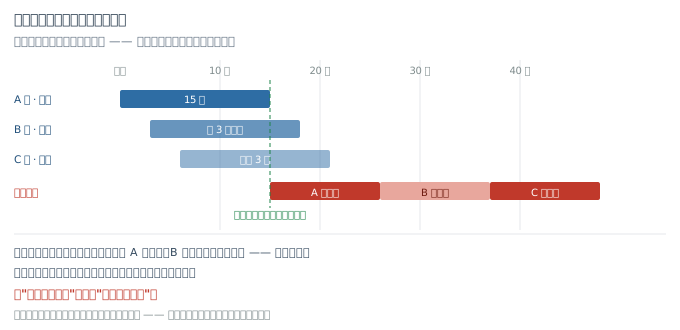
Look at one boat and the process is what blocks you. Schedule a dozen together and it is people.
4. Which days cannot be used at all (the project calendar, in Project)
Renovation has its dead days too: the estate bans work at weekends; the workers go home for the Spring Festival; the waterproofing has not cured so the flood test cannot run. It is not that you do not want to work. It is that you cannot.
The boat sheet draws those days as their own rows. Unsuitable-for-hull-movement days, in groups of 4 days every 15 — the tide is wrong on those days and a hull cannot move. Spring Festival: 29 days of shutdown, splitting some boats' work in half.
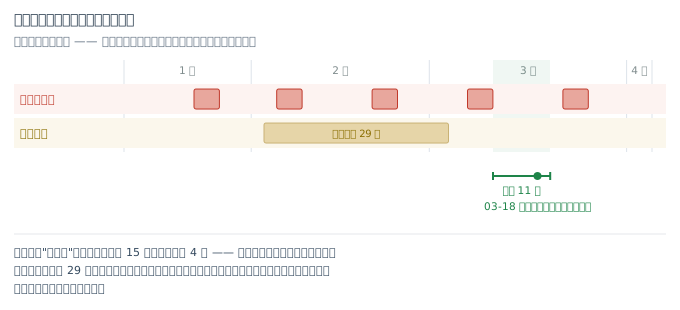
Launch can only fall inside the roughly 11-day window between two groups of red cells; miss it and wait another 15 days. When I marked those rows back then it did not seem like much. Looking at it now, this is the most valuable part of the whole sheet: what you cannot control gets its own row, and lands on specific dates. Not "as the situation allows", but "not on that day".
5. Duration is set by the slowest chain (the critical path, in Project)
Who sets the duration of a renovation? On site, plumbing and electrics, tiling, carpentry and painting run one after another in 40 days. Bespoke cabinets take 33 days from measuring and ordering to fitting. The move-in date is set by the slower of the two — which is why people who know the trade order the cabinets on day one.
Boats are the same.
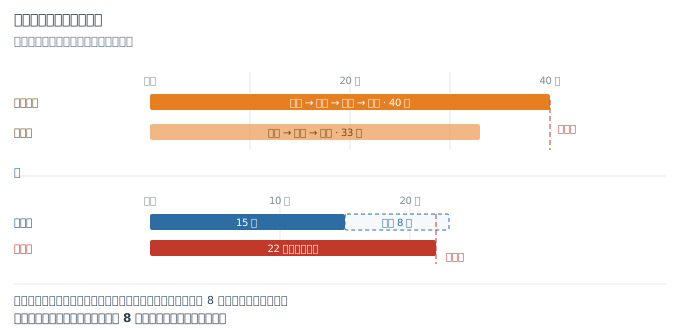
The hull line is 15 days; the outfitting line is 22. Push forward from the start and back from the delivery date, subtract the two: the hull line has 8 days to spare, the outfitting line has not one day. The delivery date is set by that 22-day line. The extra 8 days are not a holiday. They are for the unexpected.
6. So which date do you promise? (duration, in Project)
A renovation company that quotes reliably will have priced in "the rainy season, tiles drying slowly"; the ones that slap their chest and say "45 days, definitely" are the ones that run late. The difference is exactly this: whether the variability of the work itself was included.
The day counts on the boat sheet were asked for, not guessed: ask the man who does that job how long it took on the last boat. This plan was lucky — the same hull had been built 12 times and was very stable overall. But the variation had not disappeared. It was all bunched into inspection.
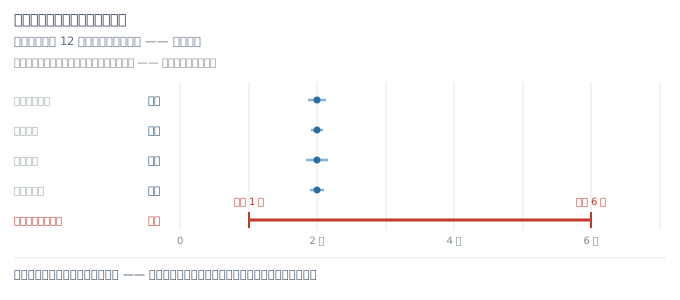
Before you quote a date, look at where the variability bunches — that is where the allowance belongs. "This one will be about the same" only holds for work you have repeated. The first hull, a new trade, a new supplier — none of them can be relied on.
7. Once it starts, are we ahead or behind? (earned value analysis, in Project)
Two weeks into a renovation the owner asks the foreman: ahead or behind? The foreman says: going fine. That answer is unusable. It is not a number and it cannot be checked.
The boat sheet has a crude method: one cell per day. By the plan, 50 cells should be done by today. Count: 40 are actually done. 40 ÷ 50 = 0.8, and that is schedule efficiency — Project calls this whole approach earned value analysis, and the index SPI. It turns "going fine" into a number you can compute: 50 cells of time have passed and 40 cells of work are done, so at this pace every remaining stretch runs a quarter late.
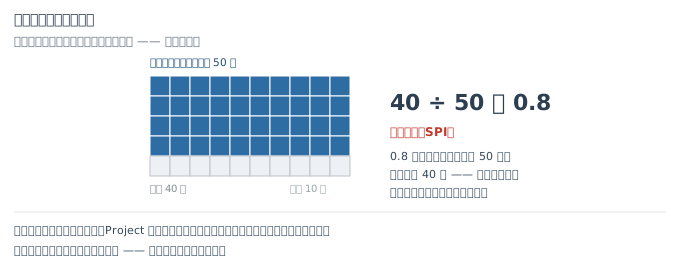
Count the cells once a week and slipping shows up immediately — you do not have to wait until the delivery date to be shocked.
Finally: take this sheet back to your own project
There are no progress bars on that sheet and no percent-complete figures. It works on physical things you can witness: the boat has only been launched when it is in the water. Project can hold all of that now and the tools are far stronger. But one thing has not changed: a percentage is typed in; a physical thing is witnessed. A "80% complete" with nothing physical behind it can be reported for three months straight.
Take what it does and copy it when you build your own schedule. Seven steps:
| Your project | What this boat sheet did |
|---|---|
| One: write down what is being delivered. What is the last line? | Delivery = handed over at Zhoushan, not "finished in the workshop" |
| Two: break the work down until "who, how many days, how do we call it done" can all be answered | Six rows per boat, one code per cell |
| Three: separate "the process forces this order" from "there just are not enough people" | Two crews leapfrogging across boats |
| Four: days you cannot control get their own row and land on dates | No-hull-movement days, 29 days of Spring Festival |
| Five: find the slowest chain; the duration is its timetable | 22 days of outfitting sets the delivery date |
| Six: before quoting a date, see where the variability bunches and put the allowance there | Inspection: 1 day at best, 6 at worst |
| Seven: once it runs, count the cells; do not believe "going fine" | 50 cells due, 40 done, efficiency 0.8 |
Five minutes to run through, and you have who sets the delivery date, where the allowance is, and what to watch.
A plan is not listing all the work. It is putting what you cannot control on the table too.
A sheet from a shipyard's old files. The dates, processes and sequences on it all come from the master production schedule I handled at the time. The names of people and yards involved are not disclosed.