I pulled up Dubai's curve for the whole year first.
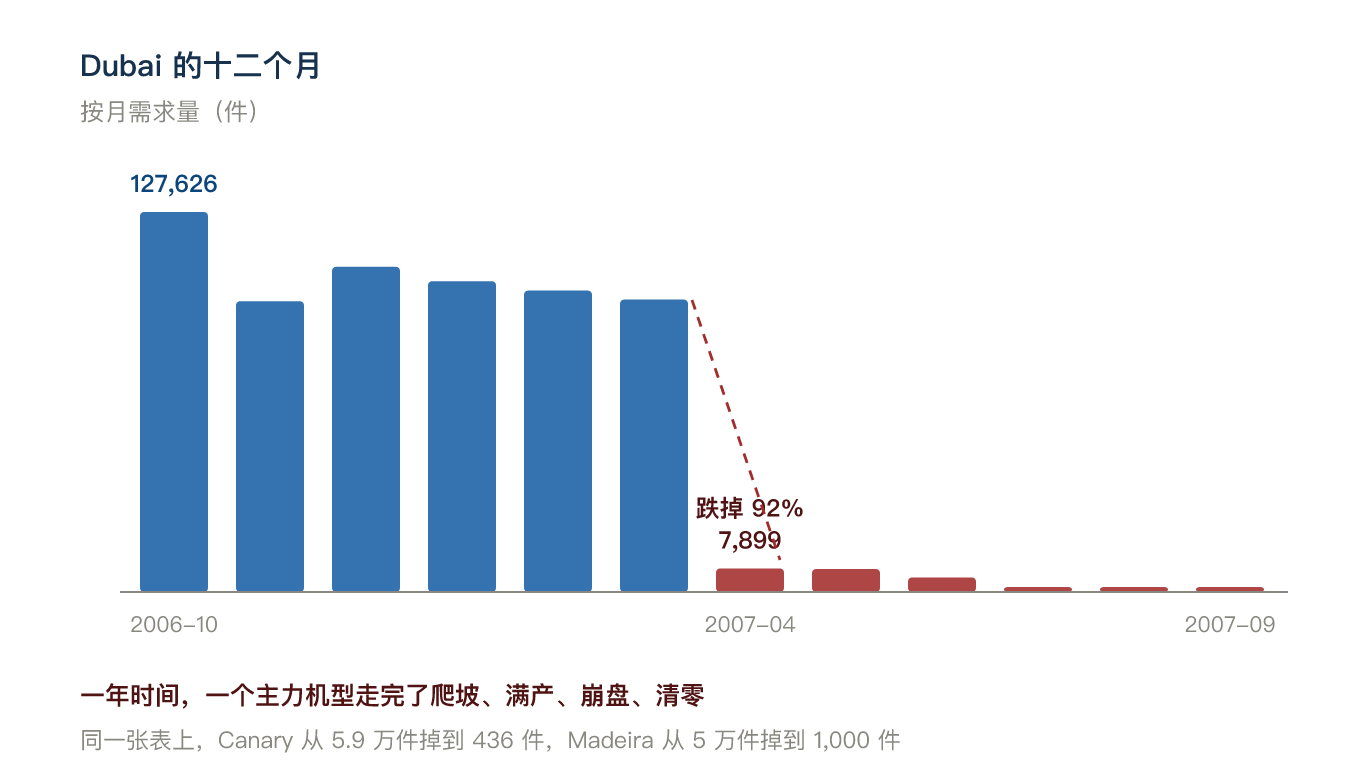
From 120,000 units a month, down to 350. Ramp, full production, collapse, embers, zero.
The life and death of one model, lying complete on a single sheet.
And it was not alone. On the same sheet, Canary fell from 59,000 to 436, Madeira from 50,000 to 1,000.
We like to think a plan, once made, holds.
The truth is that a plan is a sheet that can change its face every time it refreshes.
So what do you do with the material?
To answer that, you have to answer an earlier question:
Can this material be moved to another model?
I went and checked the configuration table.
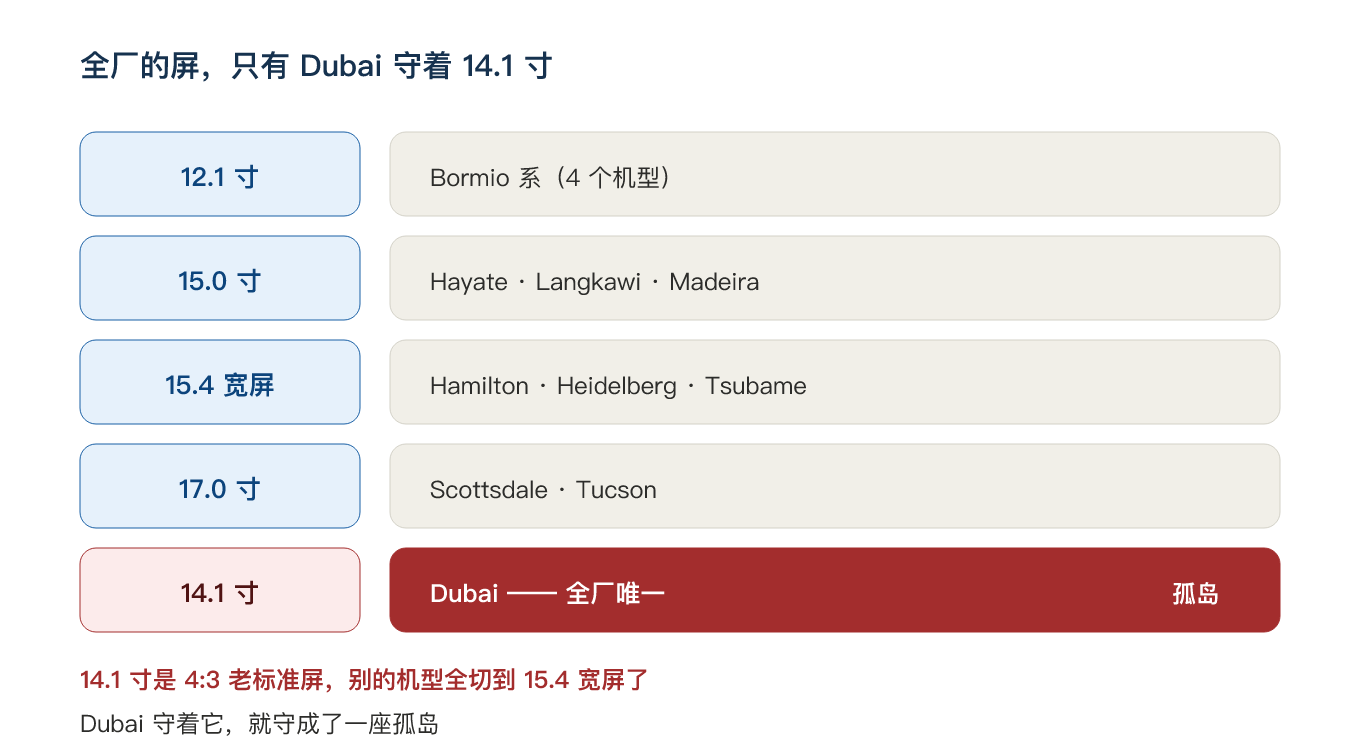
Dubai used two kinds of 14.1-inch screen. And of every model in the plant, the only one on 14.1 inches was Dubai. The Bormio family used 12.1 inches; Hayate and Madeira used 15; Hamilton and Heidelberg used 15.4 widescreen; Scottsdale used 17. Nobody touched 14.1.
Not because they did not want to — 14.1 inches was being retired as a specification. It was an old 4:3 standard screen, and the whole industry was moving to 16:10 widescreen.
Dubai, sitting on 14.1 inches, had sat itself onto an island.
That is not my guess. The evidence is written on the same sheet.
In the month Dubai fell to 7,899, another model, Hamilton, was ramping from zero. Hamilton used a 15.4-inch widescreen.
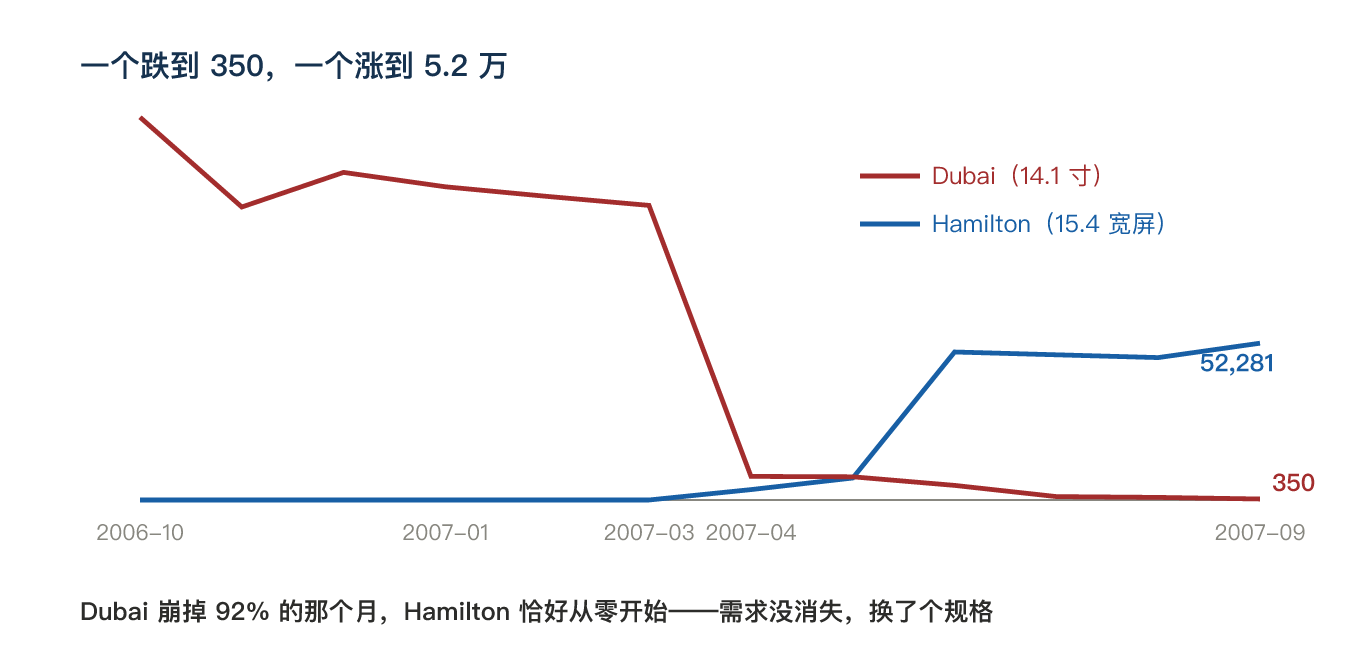
By September Dubai was down to 350 and Hamilton was up to 52,000. One machine goes down, another comes up, and the screen changes from 14.1 inches to 15.4 widescreen.
The demand did not disappear. It changed specification. The life and death of a model is, very often, the life and death of a specification.
And here is the counter-intuitive part: there was no shortage of 14.1-inch suppliers — Samsung, Chi Mei, AU Optronics, Sharp, Toshiba Matsushita, five of them supplying.
Five suppliers looks like plenty of fallback.
But once the specification dies, all five will move the 14.1-inch lines to widescreen together.
A crowd of suppliers cannot save a dead specification.
And whether we could move it never even reached the "negotiate" stage.
Dubai's screens were 14.1 inches, the other models were 15.4 widescreen — size, connector, backlight, all different.
A 14.1-inch screen does not fit into a 15.4-inch housing, and does not connect to a widescreen interface.
This is not a part-number problem. It physically will not go in.
So "move it to another model" was cut off at the physical level.
What, then, could save that material?
This was not solving a sum. It was fighting a hard fight with the suppliers.
Digging through the archive I found how Toshiba and those panel makers handled "surplus material" in those years — return notes, debit notes, credit notes, compulsory issues out of consignment stock, the whole set.
In other words, "sell it back to the panel maker at a discount" was never a matter of making a phone call. It was ground out between purchasing and suppliers, round after round of returns, deductions and discounts.
All I can say is that three roads lay there:
Sell it back to the panel maker at a discount. Other plants were still using 14.1-inch screens so they could be resold — but at a discount.
Turn it into after-sales spares. The old 14.1-inch machines were still under warranty; hold back a small batch and let it draw down slowly.
The rest: clear it at a discount, or scrap it. Every extra day on the shelf is another day of cash pinned down.
Not one of the three roads is easy.
What the Dubai case finally taught me was not "plans change their face."
It was this:
When you meet a material, first work out whether it is an island.
A material used by one model only, on a specification that is being retired — nothing happens to it, normally. And when something happens, it is fatal.
So afterwards I set myself two rules:
Meeting a new material, ask first: who else uses this? If there is no second user, it is an island material — before you buy, see clearly where its lifeline runs.
For island materials you cannot avoid, stock them the other way round. Cap the quantity, negotiate the return and deferred-delivery terms up front, and prefer small and often to one big pile.
Because the thing an island material fears most is not a price rise.
It is demand disappearing, and you having nowhere to send it back.
Against a plan that changes its face daily, the real skill is not in how accurately you forecast.
It is in how early you spot which materials are islands with no way back.
Plans change their face. Islands have to be spotted early.
I have stepped in these pits ahead of you. We will fill them in one at a time.