Early in 2020 you almost certainly did one thing: you stocked up on masks.
There was half a packet at home. The moment you heard "there is going to be a shortage", you bought ten packets at once. You knew perfectly well you would not use them all — but you knew better still that next time the shelf might be empty.
Everyone around you made the same decision. So the next day masks were dearer and scarcer, and more people rushed into the pharmacies.
Nobody in that story did anything wrong. You stocked up for your family. The pharmacy raised prices because its own purchase price had risen. The wholesaler ordered more for fear of running out. Every link did the thing that was safest for itself.
And all of them together multiplied the shortage tenfold.
We were not the first queue of this kind. In the United States in 1933 people queued outside banks to withdraw their money — the more they withdrew, the faster the banks failed, and the faster the banks failed, the longer the queue. Two queues, one at the pharmacy and one at the bank, ninety years apart, and both were queuing for the same thing: fear.
The phenomenon has a name: the bullwhip effect.
Anyone who has cracked a whip knows it. A light flick of the wrist, and the tip cracks out metres away.
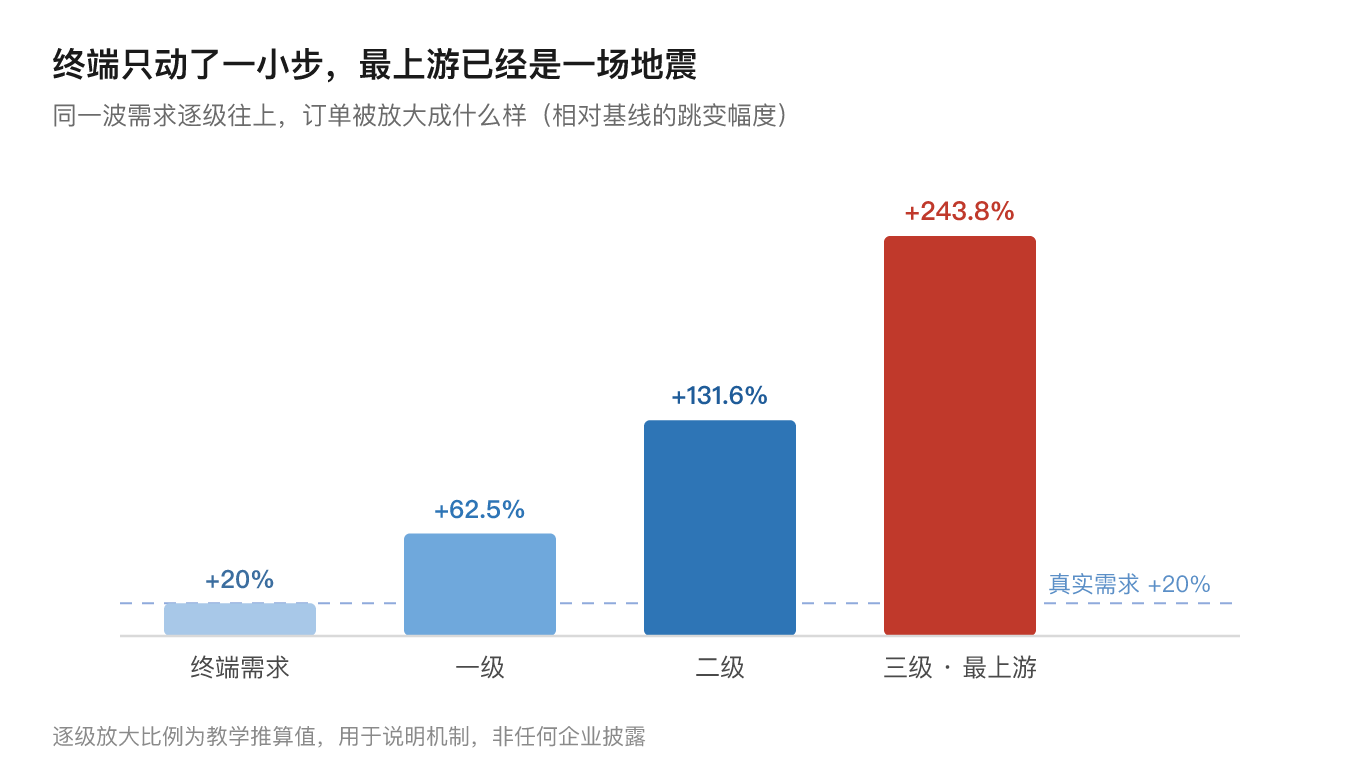
A supply chain is that whip. One person's panic is nothing. Everyone's panic stacked along the chain is a catastrophe — and the longer the chain, the worse it lands.
Two years later the same script played out on a chain ten thousand times longer. This time the lead was chips.
2020: hitting the brakes
Then came the pandemic, and cars stopped selling. The US market fell about half, Europe eighty percent, China seventy. The first thing carmakers did was cut their chip orders — if you are not building cars, what do you want chips for?
In isolation the decision was not wrong. You did not know when the car market would come back, or whether the fab would hold capacity for you. On the fab side, capacity was switched over to consumer electronics.
2021: turning round and fighting for it
The car market came back. The chip capacity had already gone to somebody else. Everyone turned round and fought for it.
Consultancies forecast at the start of the year that the shortage would cost the world 2.2 million vehicles of production. By September reality had chased that number up to 7.7 million vehicles and 210 billion US dollars of losses. Chip lead times went from 6 to 9 weeks in 2019 to nearly 26 weeks by the end of 2021 — order today, wait half a year. On the black market a chip worth a few yuan changed hands for thousands. Gamers could not buy consoles. Even fridges and washing machines ran short of chips.
Capacity was tight and there was not enough to go round. How was it allocated? Whoever had the biggest order got the most.
So every buyer did the same arithmetic. If I report my true 100 and the man next door reports 150, and allocation is pro rata, then I lose.
It is not greed. If I do not pad the order, I genuinely do not get the parts.
Tier one padded. Tier two saw orders rise and padded too. Real demand went up twenty percent; what the furthest upstream saw was +244% — and nine tenths of that was panic. Every padded order was placed by fear.
2022–2023: settling up
The capacity everyone had fought to build came on stream, and demand turned round. Samsung's quarterly profit fell 95%. TSMC cut its revenue guidance for the first time in thirteen years and cancelled forty percent of its equipment orders.
Whoever fought hardest for it lost the most. The padded orders became warehouse after warehouse of chips, waiting for demand to come back — exactly like the masks from the earlier panic, piled up until they expired.
Three years, and one chart shows it more clearly.
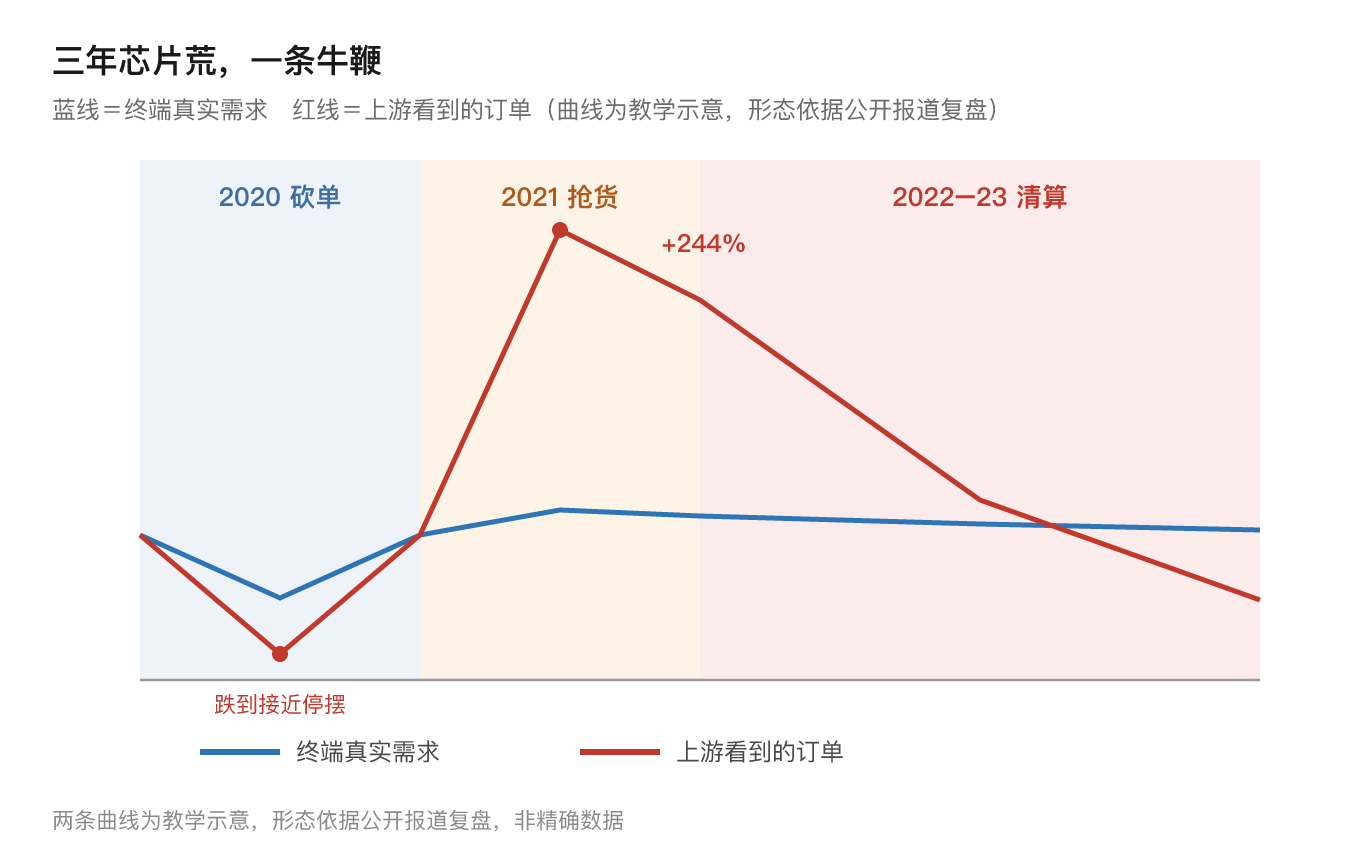
The blue line is real end demand: it falls, it bounces back, then it flattens. The red line is the orders that upstream saw: cut to almost a standstill, up to +244%, then collapse. Every time, the red line whips further than the blue one. That is the shape of the bullwhip effect.
Nobody won this shortage. The 210 billion dollars did not go into anyone's pocket. The whole chain burned it, in a panic.
And here the problem starts
There was no secret in any of it. The bullwhip effect is in every textbook and the prescription was written long ago: when you are short, do not allocate by order size — allocate by the real share of the last twelve months. Change the rule and grabbing is worth nothing. The tools genuinely work too: if every tier can see real end demand, +244% collapses to +62.5% at once.
But +62.5% is not zero. Information sharing cures double forecasting. It does not cure grabbing.
The only cure for grabbing is changing the rule. So who changes first? Inside a rule where whoever grabs gets, the one who lets go first loses first. Grabbing is the dominant strategy for every player: whether the others grab or not, grabbing does not cost me. Everyone works it out that way, so everyone grabs.
And somebody did try to put a hand out first. At the height of the shortage TSMC noticed it was shipping more chips than were actually being used — somebody was holding stock. Chairman Mark Liu told Time that somebody in the supply chain was certainly hoarding chips. He had customers' data cross-checked, and pushed non-urgent orders back.
And then he stopped. He did not dare announce "in a shortage we allocate by real share, and whoever hoards gets cut off" — that means offending a group of large customers first, and the first casualty of the new rule would be himself.
The most powerful capacity holder in the world stretched a hand halfway out, and could only pull it back.
It does not lack clever people, and it does not lack methods. What it lacks is a rule that makes everyone stop at the same time. One company letting go achieves nothing.
Put yourself inside it. You are the buyer, there is not enough to go round, you honestly report your real demand, and your line is waiting and your customer is chasing — while the man next door reports three times as much and takes the majority. Next time, do you still report honestly? This is not a question of conscience. It is a question of arithmetic: the honest man is eliminated first.
For two of those years I was sitting on one link of that chain myself, grabbing and being grabbed. One thing I know clearly: in that position, grabbing is precisely the only rational choice. The bitterest irony of the whole farce is this: everybody making the most rational decision walked the collective into the most irrational outcome.
Rules can change incentives. They cannot change fear.
Remember the queue outside the bank at the start? What got that queue moving was Roosevelt. On the day he took office he left a line that has lasted ninety years: "The only thing we have to fear is fear itself."
He did not tell people not to be afraid. He treated the fear. He closed the banks for a few days and used the radio to explain to ordinary people, one broadcast at a time, where the money was and why there was no need to run. Within weeks the deposits began flowing back.
There is only one cure for fear: turn "not knowing" into "knowing".
The next time a shortage comes — and there will be a next time — ask yourself one question first:
Is this extra I am asking for now demand, or is it fear?