The harness passes through the sheet metal cabinet. The steel is punched, and every hole leaves a burr — untreated, it will wear through the cable before long.
So every punched hole needs a rubber grommet. The grommet is there for the harness: the harness goes through, one grommet per hole.
Nothing special. A dozen per cabinet, a few yuan each, sitting well down the purchase order. We bought them from a rubber parts maker.
Later I had to find a supplier for a harness.
Harnesses look simple and have plenty of traps. We used them in inverters: in one cabinet there are high-voltage wires, low-voltage wires and signal wires. Three kinds bundled into a single harness, with the connector, the length and the grommet positions all set by the cabinet.
I started by searching online. Directory listings run on forever, but a listing is not a capability — it does not tell you whether this factory can make your material, whether it has the capacity, or whether it wants your kind of volume. What you find online suits greenfield exploration. It does not suit choosing a partner.
I did the trade shows too. You can look at dozens in a day, which beats a listing — at least you can ask a question to someone's face. But it solves "understanding this industry", not "this particular material": the tier you need may not be there that day, and the ones who are may not take your volume.
With both routes tried, the real problem showed itself. What blocked me was not a lack of places to look. It was that the middle band is thin to begin with.
There are only two kinds of factory you can reach.
One kind is too high a class. They supply cable brands like Nexans — the French company, and the cable in our cabinets is its cable too. Process, certification and management are impeccable, but the minimum order is large and the price is high, and our volume does not clear their threshold.
The other kind is too low a class. Small shops, not much scale, willing to take anything. But they cannot make our specification: three kinds of wire in one bundle, and certification to pass as well — a small shop's equipment and process will not hold up.
The big houses have a high ceiling and a high doorway; the small shops have a low doorway and a low ceiling. Volume in the middle, specification in the middle, and neither end wants it.
It simply does not show up.
That time I was in a meeting with the grommet maker. The agenda was not about finding a harness. Halfway through I mentioned it in passing: I have been looking for someone who can make harnesses, the specification is on the messy side, the volume is not large.
The man from the grommet company did not pause. He said: there is one. We supply them all the time. They should fit.
That was the whole sentence.
How could he think of it straight away?
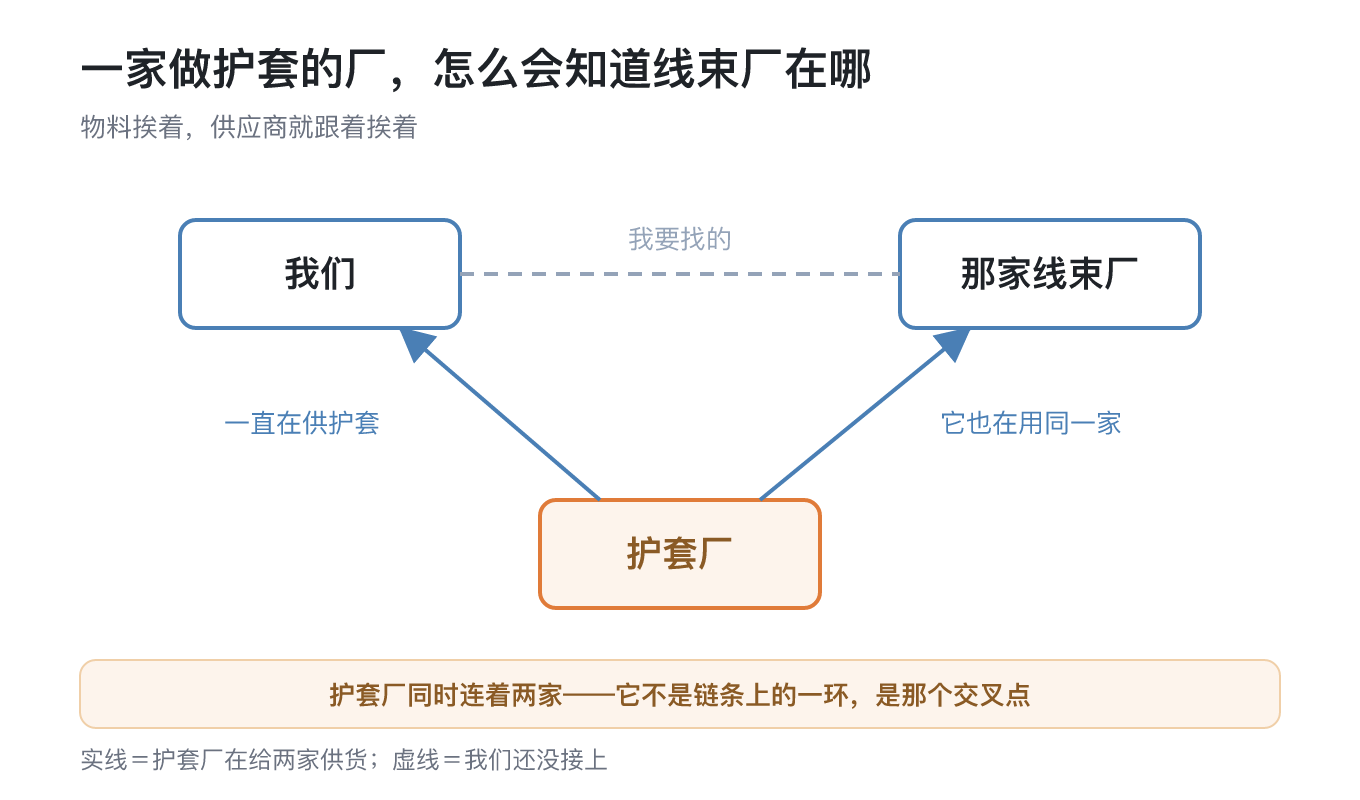
Because he supplies both sides at once.
He supplies us grommets — the cabinets need grommets. He also supplies grommets to the harness maker — because the harness itself needs grommets. The harness passes through the sheet metal cabinet, the burr at the hole abrades the cable, and every hole gets a grommet.
Which is to say: at the material level, the grommet and the harness sit next to each other.
When materials sit next to each other, suppliers do too. The grommet maker looks up and sees the harness maker. They serve the same set of OEMs and they deliver, meet and quote in the same circle all day.
And the network has more than one edge: terminal makers supply terminals to harness makers; sheet metal cabinet makers need harnesses fitted; connector makers connect to both. Behind every pair of adjacent materials stand two adjacent factories.
I could not stand in that position myself. My list contained only "the ones who supply me directly". The harness maker was not on my list. He was on the grommet maker's list.
This road has a price. Let me say it plainly first.
What a supplier recommends is usually someone in his own circle. Same region, same class of process, maybe trained by the same man — similar strengths and similar weaknesses. You can go round and round and still be inside those same few circles.
And the more he recommends, the more weight that supplier carries with you.
So a recommended supplier still goes through everything that follows: agreement, drawings, price comparison, site visit. It earns a "look at this one first". It does not earn a "put it straight on the list".
That harness maker went through the whole set and made the list. Harnesses, fibre optic cable, CAN bus cable — we bought from them for years afterwards.
That sentence landing on my ears was a bit of an accident. The meeting had been held many times. In someone else's ears the same sentence is just small talk.
It was not that I lacked channels. I searched what could be searched and looked at what could be looked at — "harness maker" returns a long list. But the tier I actually needed — small volume, messy specification, and somebody willing to take it — those conditions do not fit into any search box.
The sourcing process I had ran all four stages without missing a step. But it governs everything after "I already know what to buy" — from the moment my bill of materials is written.
The hardest step comes before the process starts.
That is not a missing box on the form. That step does not belong on the form at all: the form records purchasing that has already been thought through, and "who should I be looking for" happens while you are still thinking.
Further down lie the real hard parts of finding a supplier — how to sign, how to ask, how to read a site, how to work out total cost, how to get onto the list. I have a form for each of them, and every one has its pits. The next few posts take them one at a time.
The factory you are looking for is on your supplier's customer list.