One year. The same cabinet. Two versions of the cost sheet.
The contractor's package had come down by 7.4%.
The contractor offered that cut on its own. I took one look, thought it was fine, and signed.
Years later, I finally went back and did the math.
The cabinet
At the time I ran purchasing for a company that made industrial power converters.
A converter is a cabinet taller than a man. Inside are power units, chokes, capacitors, copper busbars, wire harnesses, and screws in dozens of sizes.
We didn't assemble the cabinet ourselves. The cabinet body and most of the assembly went to a contract manufacturer. Our people were based in their workshop.
From 2015, we built about four hundred of these cabinets a year.
Between September 2017 and November 2018, the price of the contractor's cabinet package dropped 7.4%.
Part of that cut we asked for. Most of it, the contractor offered on its own.
What I thought at the time was simple: a supplier lowering its price without being asked is good news.
First, the rule
It is called the learning curve. Nearly ninety years ago, someone in an aircraft factory noticed that the more planes of one type you build, the fewer hours each one takes — and the drop follows a very regular pattern.
The rule is one sentence: every time cumulative output doubles, unit cost falls by a fixed percentage.
Say the first unit costs 100. On an 85% curve:
At 2× the output, 85.
At 4×, 72.
At 8×, 61.
At 16×, 52.
However many times output doubles, multiply by 0.85 that many times.
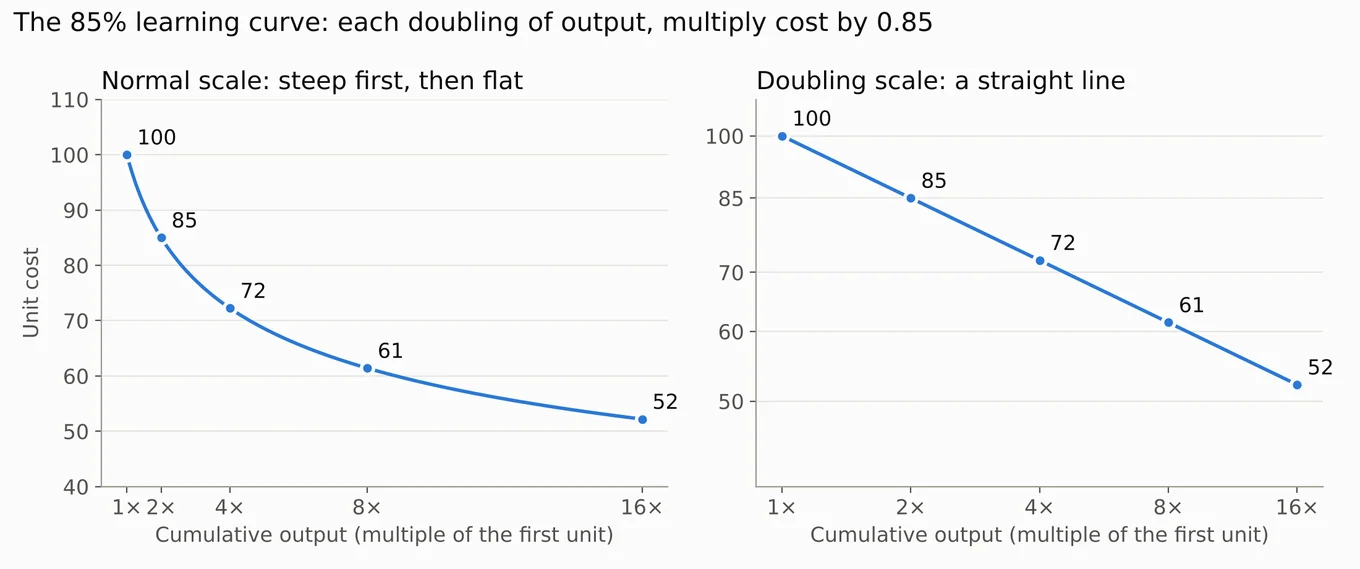
On a normal scale it is a curve that keeps flattening. On a doubling scale it is a straight line.
One thing people often get wrong: the horizontal axis is output, not time.
If output doesn't move, the curve doesn't move, however much time passes. So when you use it to negotiate, the question is not "how much did the price fall last year?" but "how many doublings has our volume gone through?"
How steep the curve is depends on the kind of work. Cost estimators use a common table of rules of thumb: repetitive electrical work, about 75% to 85%; purchased parts, 85% to 88%; raw materials are the flattest, 93% to 96%.
What we bought from the contractor was an assembled cabinet package. As a purchased part, that puts it at 85% to 88%.
How the curve actually comes down
The formula tells you how much cost should fall. It doesn't tell you why it can fall.
Many people think the learning curve just means workers getting faster with their hands. That is less than half the story.
Once, we and the contractor's people held a meeting in their workshop. A group of us spent several days around the cabinet, writing down every place we could save, one line at a time.
I have kept that list. It has about sixty lines.
When I took it apart, I saw that the curve comes down one layer at a time.
Layer one: practice.
By the hundredth cabinet, a worker knows which panel goes in first and which cable comes next, without checking the drawing again. This is the layer people usually talk about. It is also the shallowest.
Layer two: do less.
The biggest group on the list was screws.
One line said: for each panel, count how many screws it really uses.
A later line went further: cut the number of screws by at least half.
On one mounting plate, 6 screws became 4. Earthing pieces, cut by half. Between the cabinet sections there were 5 cable grommets that no cable ever passed through — remove them.
One less screw doesn't just save the screw. It saves the seconds spent driving it in.
Layer three: make it simpler.
Standardise screws and nuts. Use as few sizes of cable gland as possible.
The list had an example: one plexiglass shield held by 4 screws needed 2 different bits to take off.
And: every cabinet shipped with two different floor plates. Could we send just one?
Fewer variants means less stock, and fewer chances to fit the wrong part.
Layer four: change the design.
Roof sheet from 2 mm to 1.5 mm. The plexiglass shield replaced with steel mesh. Two radiators merged into one big one. A busbar narrowed from 175 mm to 150 mm.
At this layer, the workshop has no say. The drawings belong to R&D. R&D has to agree.
Layer five: change the specification.
Could one component's rating be relaxed from 3 seconds to 600 milliseconds? Could the condensation monitor become an option?
At this layer, even R&D has no say. The customer has to agree.
Laid side by side, the five layers showed me two things.
First, the deeper the layer, the bigger the saving, and the harder it is.
Practice, the workers manage themselves. Doing less and making it simpler, the contractor can decide on its own. Changing the design needs our R&D. Changing the spec needs the customer.
Every layer down adds one more person who has to say yes.
Second, from seeing a saving to banking it is a long way.
When that list was filed, out of about sixty lines, exactly one was marked "achieved" and one "in progress".
The rest were still on paper.
There was one note I still remember. It sat after "standardise cable gland sizes", in brackets:
(best savings on protos.)
The earlier the batch, the easier the drawings are to change and the more you can still move. That is why the curve is steep at the start and flat later.
The list had one more line: keep pressing suppliers for lower prices.
Out of about sixty lines, that was the only one about squeezing the price.
This is what the learning curve looks like on the ground: not a line that slides down by itself, but a pile of small things that someone has to raise, someone has to approve, and someone has to finish.
And most of those small things happened in the contractor's workshop. The hours and material they saved landed first in the contractor's books.
Doing the math afterwards
Now back to that 7.4%.
That year, cumulative output of this cabinet went from about 600 units to just over 1,000. Less than one doubling — about 0.74 of one.
On a purchased-parts curve of 85% to 88%, the package price should have landed between 88.7 and 91.0.
The quote that came in was 92.6.
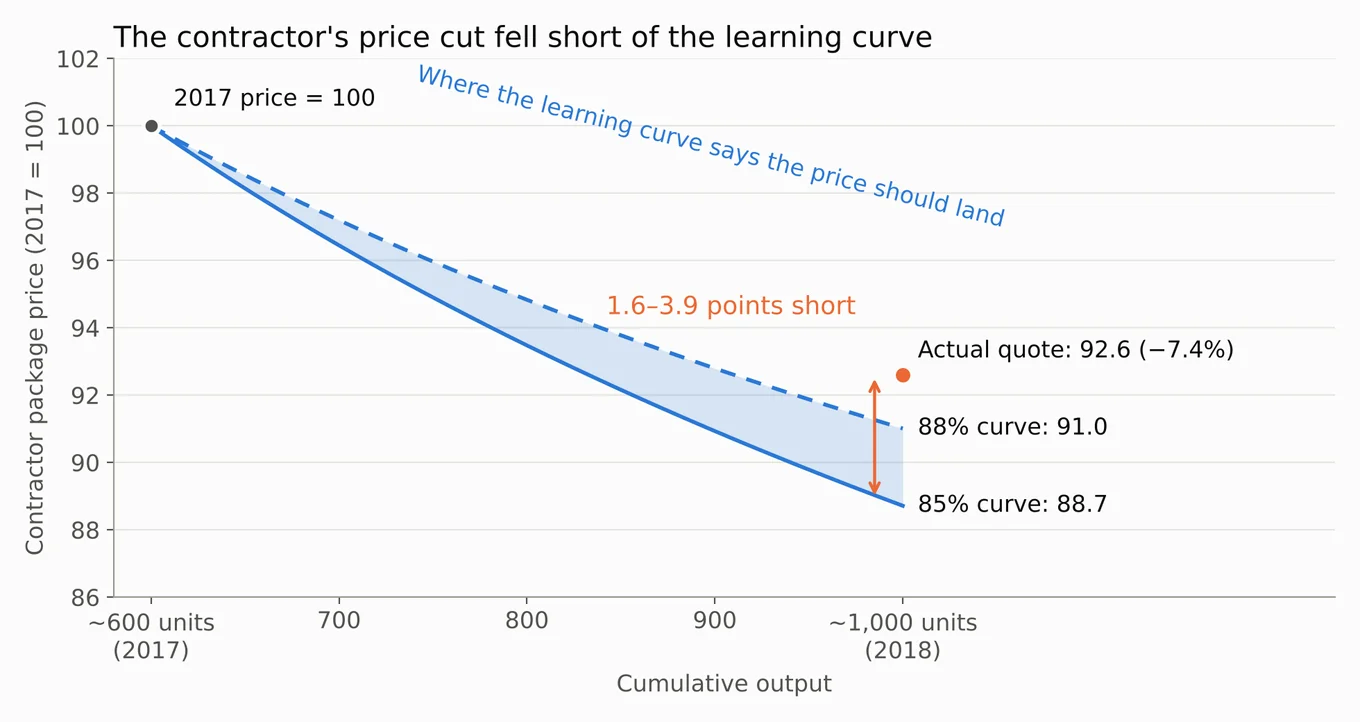
It should have dropped 9% to 11%. It dropped 7.4%.
Those two to four missing points didn't disappear. They stayed with the contractor.
I'm not saying the contractor did anything wrong. Offering a price cut unasked is more decent than many suppliers.
The problem was on my side: I never did the math.
I didn't have a number in hand. So whatever they quoted, all I could judge was "it went down, good" — not "did it go down enough".
Who decides how much
The learning curve is a line you can calculate.
But the money saved along that line doesn't walk into the buyer's books by itself.
That list was written in the contractor's workshop. The screws were left out in the contractor's workshop. We paid a price for the cabinet package, not for their labour hours.
Whoever works out the number first holds the starting point of the negotiation. If you don't do the math, the other side does it for you. And the number they come up with will look after them first.
That 7.4% — the other side opened the door, and the other side decided how wide.
If the buyer doesn't claim it, the gain goes to the seller.
So the next time a supplier offers you a price cut on its own, don't rush to sign.
Ask one question first: how many doublings has our volume gone through?
Twenty-odd years in this trade, and I've paid for "could have worked it out, didn't" more than once. In the notes to come, we'll fill these holes one at a time.
The last price cut from your supplier — did you work it out, or did they hand it to you? Tell me in the comments.
One email when the next chapter goes up
No drip campaigns, no selling. Your address stays with MailerLite and unsubscribes in one click.