In September 2020, a colleague and I went to Jiaxing to look at a candidate supplier.
Before we set out, their sales rep sent me a WeChat message: Do we need to prepare any audit documents? Do you have a checklist you can send over first so we can line things up?
I replied: No need to prepare anything. When we arrive, we'll just walk through the shop floor.
We spent less than half a day at the plant. Back at the office, I opened the rapid plant assessment sheet on my laptop and filled in the thirty-eight items we had just observed.
A radar chart popped up automatically on the right side of the spreadsheet.
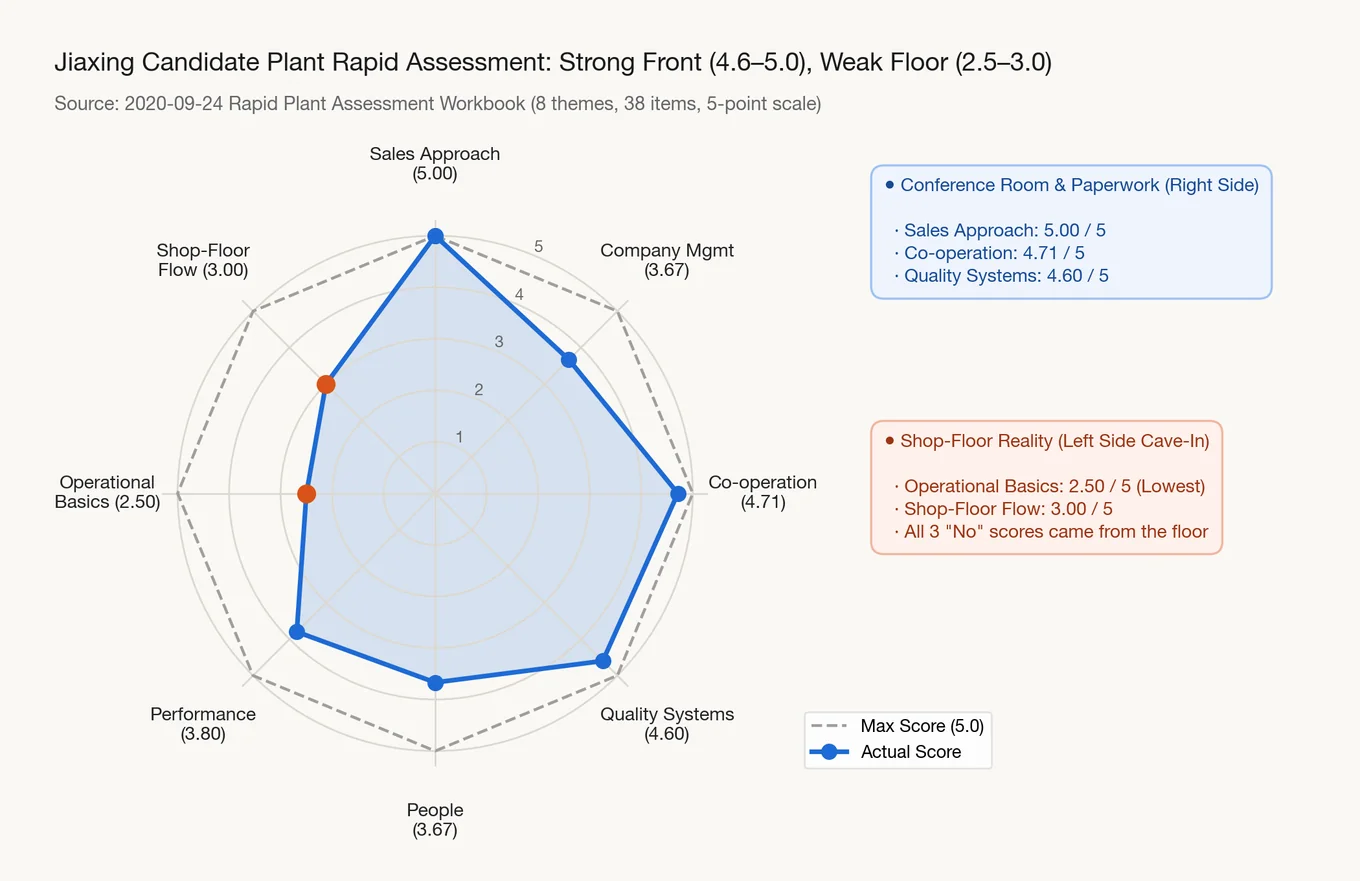
A full score is 5.
Look at the right half of that chart. The blue line hugs the outer ring: Sales Approach scored 5.00, Co-operation 4.71, and Quality Systems 4.60 — the owner met us in person, answered every question without hesitation, and laid their ISO 9001 certificate right on the conference table.
Now look at the left half. The polygon caves in: Operational Basics scored 2.50, and Shop-Floor Flow scored 3.00 — no safety briefing when entering the workshop, 5S existed only on wall banners, and nobody had ever calculated the cost of scrap or rework.
The same factory. The same morning. Full marks across the conference table; the bottom falling out on the shop floor.
Had I emailed the checklist three days ahead, they would have swept the aisles overnight, printed a few fresh visual boards for the walls, and papered right over that crater on the left side.
That is why, on a first visit to a supplier's plant, I always carry a form in my head — and never send it ahead.
Today let's unpack this sheet and walk through how to use half a day and one two-page tool to read a factory's true baseline on your very first visit.
First: What the Sheet Looks Like and How It Works
The method is called Rapid Plant Assessment (RPA), originally developed by professor R. Eugene Goodson at the University of Michigan's Ross School of Business after studying more than four hundred factories. The several versions I have used over my career are all built on this foundation.
Its goal is dead simple: without flipping through thick binders or sitting through two-hour slide decks, spend thirty minutes to two hours walking the floor to answer one question — is this plant worth investing our next round of engineering and audit resources?
The standard sheet has only two core pages:
Page 1: 11 Assessment Categories.
They run from Customer Satisfaction, Safety & Order, Visual Management, Scheduling System, Space & Material Flow, and Inventory & WIP Levels, through People & Morale, Equipment Maintenance, Complexity Management, Supply Chain Integration, and Quality System Deployment.
Each category is scored on an odd scale only: 1 (Poor), 3 (Below Average), 5 (Average), 7 (Above Average), 9 (Excellent), or 11 (Best in Class).
Added together across the 11 categories, the total score runs from 11 to 121. Across the global benchmark database of hundreds of plants, the industry average is 55, with the vast majority falling between 30 and 90.
In plain terms: around 55 is a respectable, average factory.
Page 2: A 22-Question Yes/No Walkthrough Questionnaire.
Those 22 questions aren't summed directly into the total score. They serve as your observational anchor while you walk the floor — each question maps to one or two of the 11 categories above. Once you have answered all 22 observable facts with a hard Yes or No, scoring the 11 categories ceases to be guesswork.
There are only four rules when using this sheet:
Rule 1: Never send it to the supplier in advance.
Scheduling the visit is fine; normal hospitality is fine. Not a single word of the scoring criteria goes out ahead of time. In fact, the scoring guide for Category 2 (Safety, Environment, cleanliness & Order) includes a specific penalty: if you can tell the floor was temporarily dressed up for visitors ("spiffing for visitors"), you don't add points — you deduct them.
Rule 2: Go as a team of two or three, and carry no clipboards on the walk.
Ideally, bring one person each from Purchasing, Quality, and Engineering. Walk onto the shop floor empty-handed. Do not carry a clipboard ticking boxes as you walk — the moment you look down to check a box, the plant manager beside you tenses up, and every answer from that point on turns into a rehearsed script. Keep the 22 observation points in your head and just walk and look.
Rule 3: Score independently back in the meeting room or at your desk — no conferring.
Once the tour wraps up and you sit back down in the conference room or return to the office, each team member fills out the sheet independently. Nobody compares notes until every score is locked in.
Rule 4: Look beyond the average — look at the divergence.
When the three sets of scores are combined on one sheet, check first whether the composite score clears the 55-point benchmark. Immediately after that, check the standard deviation (SD) on every row.
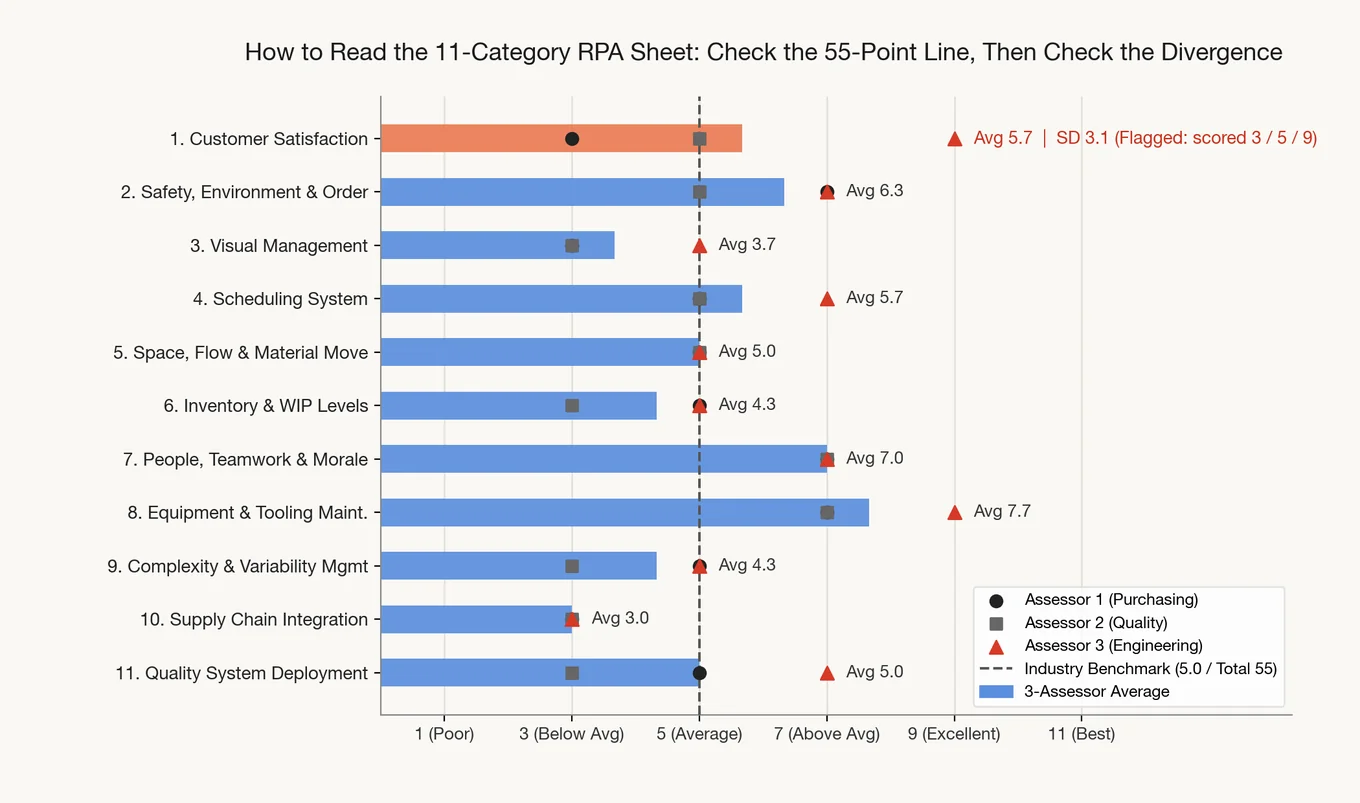
Take Category 1 in the chart above. The plant's composite total is 57.7 — just above the passing line. Yet on "Customer Satisfaction," Purchasing saw no customer scorecards posted on the shop floor and gave it a 3; Quality saw certificates and thank-you plaques in the lobby and gave it a 5; Engineering liked the marquee customer logos on the company website and gave it a 9.
The same factory, the same morning, and three assessors walk away with 3, 5, and 9 (a standard deviation of 3.1). The sheet automatically flags any row with SD ≥ 3 in red. You don't need to argue over who is right — the divergence itself is the biggest piece of intelligence. It tells you that what the factory showcases externally is disconnected from what reaches the shop floor, and tells you exactly where to dig during verification.
The 6 Hardest Walkthrough Questions — and Where to Look on the Floor
Out of the 22 walkthrough questions, several can be judged at a glance — such as whether lighting, air quality, and noise levels are well controlled (Question 3), or whether work instructions are posted at workstations (Question 8).
A handful of questions, however, read like abstract textbook slogans. If you ask the plant manager escorting you, the answer will be an enthusiastic "Yes, absolutely, we do that every day" ten times out of ten.
You cannot judge these questions with your ears. You have to judge them with your eyes. Here are the 6 hardest questions on the sheet, and the exact physical clues to look for on the floor.
Hard Question 1: "Are production lines scheduled by a single pacing process?" (Question 11)
This question feeds into Scheduling System and Inventory & WIP Levels.
If you ask the plant manager, "Do you schedule via a single pacing process?", he will tell you: "Yes! Our Production Control department issues one master schedule for the whole factory."
That is not what the question is asking. It is asking whether material moves through the workshop by push or by pull.
How do you tell on the floor?
Look at two things: first, how many workstations receive written production dispatches; second, how much material is piled up between processes.
If you walk from laser cutting, bending, welding, and powder coating down to final assembly, and every single machine along the way has a thick clip of daily dispatch sheets hanging beside it — with each line leader running full tilt to maximize their own station's output — that is not single-point pacing. Every station is an island.
The consequence is always visible on the concrete floor: faster stations bury slower ones. You will see three days' worth of bent sheet metal stacked in front of the welding booths while final assembly stands idle waiting for one painted bracket.
In a plant with true single-point pacing, only one place on the line (usually final assembly or the pacemaker bottleneck) receives the schedule from Production Control. Upstream processes are triggered purely by empty bins, kanban cards, or bounded supermarket lanes — upstream makes a bin only when downstream pulls a bin, and you never see mountains of orphan WIP blocking the aisles.
Hard Question 2: "Is there a place for everything, and is everything in its place?" (Question 5)
This question feeds into Safety, Environment, Cleanliness & Order.
Almost every factory in China paints yellow lines on the floor and hangs signs reading "Qualified Area" and "Pending Inspection." If you stroll down the main aisle, it looks tidy enough, and it is easy to check "Yes."
How do you tell in ten seconds whether it is real workplace organization or yellow paint put down for visitors?
Don't look at the yellow lines on the floor. Look at what is inside the boxes and what is drawn on the tool boards.
First move: look at the cart parked inside a yellow floor rectangle. Does the label on the cart match the label on the floor? When plants rush to tidy up before a visit, operators shove whatever clutter is in the aisle into the nearest empty yellow box — the box is neat, but the item inside doesn't belong there.
Second move: walk up to the tool rack beside a machine. If five wrenches hang on the board, are their silhouettes outlined behind them (a shadow board)? If one hook is empty, can you tell in one second whether a 12 mm wrench is missing?
Third move — the most reliable test of all: walk straight to the corner of the shop where they keep the Non-Conforming Material / Quarantine Area (the red-tag zone).
Do the rejected parts have tags attached? Are the dates on those tags from yesterday, or from three months ago? If the quarantine cage is covered in dust, or if good parts, bad parts, and rework parts are tossed into the same blue plastic tote, then no matter how shiny the main aisle was swept, the answer to Question 5 is No.
Hard Question 3: "Are critical product characteristics identified, and are fail-safe methods used to prevent defects from passing to the next process?" (Question 19)
This question feeds into Quality System Deployment, and it is the one most easily fooled by wall certificates.
Ask a quality manager, "Do you use fail-safe methods?" Nine times out of ten, he will walk you over to an inspection granite table, point at a pair of digital calipers, a CMM, or a first-article inspection sheet, and say: "We inspect every batch strictly."
Remember one rule: Inspection is not poka-yoke (fail-safing).
Inspection means sorting out bad parts after they have been made. Fail-safing means designing the fixture or tool so the part cannot be assembled wrong in the first place.
How do you spot real fail-safing on the walk?
Pause beside an assembly station or a machining fixture and watch the operator cycle two parts.
If a component can be dropped into the jig right-side up or upside down — relying entirely on the operator's eyesight, or on a red sheet of A4 paper taped above the bench reading "WATCH ORIENTATION — DO NOT INSTALL BACKWARDS!" — that is zero fail-safing. On a 2 a.m. shift, someone will install it backwards.
True fail-safing lives in metal and sensors: an asymmetric guide pin welded onto the fixture so a flipped part physically cannot seat; a torque driver wired to a PLC counter that refuses to unclamp the fixture until all four screws hit target torque; pick-to-light part bins that sound a buzzer if the operator reaches into the wrong slot.
Unless you spot at least three physical mechanisms on the floor where an operator couldn't make the mistake even with their eyes closed, Question 19 gets a No.
Hard Question 4: "Is there an effective project management process for new product launches, with cost and timing targets?" (Question 17)
Since a rapid assessment doesn't audit computer folders, how can you tell from the shop floor whether their New Product Introduction (NPI) process actually works?
Look for the prototype area — or find a workstation currently running sample parts.
Many small and mid-sized suppliers say yes to every sample request in the sales meeting, yet have zero dedicated prototype flow on the floor.
If you walk the line and see three urgent prototype units wedged in the middle of a 500-piece mass-production batch, squeezed in whenever an operator has a spare moment; or an engineer standing beside a CNC machine holding a paper drawing crossed out three times in ballpoint pen, gesturing to the machinist to "take another half millimeter off here" — then their new product launch process is firefighting, not project management.
Conversely, if the workshop has a clearly cordoned-off prototype bay (even if it is just two benches), with a visual project tracker on the wall showing active NPI builds — listing tooling readiness dates, first-article submission dates, target cycle times, and target yields — and every prototype part travels with a high-visibility colored routing card kept strictly separate from mass-production stock, you know they understand project management without opening a single binder.
Hard Question 5: "Do employees appear happy — do they make eye contact and greet visitors?" (Question 21)
People reading the RPA questionnaire for the first time almost always chuckle at this one: I'm here to buy machined castings, why do I care whether the workers look happy?
In practice, this is one of the sharpest questions on the page. Together with Question 22, it measures workforce stability and the real relationship between management and the front line.
When a factory squeezes piece-rates to the bone, runs mandatory exhausting overtime every night, manages by shouting, and suffers 20%+ monthly turnover, none of that will ever appear in the company brochure. But you feel it the second you step through the workshop door:
A group of visitors walks down the aisle, and every operator keeps their head locked down over their bench without lifting an eyelid. Pause beside a station for thirty seconds and the worker's hands stiffen up. When the accompanying plant manager steps closer, the operator's movements visibly tense.
In a shop like that, half the skilled operators building your qualification samples today will be gone next month. How could your quality possibly stay stable?
In a well-run plant with a stable workforce, operators naturally glance up as you pass, meet your eyes without flinching, and nod hello. If you casually ask an operator, "Which dimension does this go/no-go gauge check?", they will pick it up and show you without nervously checking the plant manager's face first.
Hard Question 6: "Would you buy the products this plant produces?" (Question 20)
This is the closing question of the first twenty items, and the most subjective — yet most accurate — question on the entire sheet.
After you have walked raw material receiving, machining, sub-assembly, final testing, and shipping, and you are thirty steps from walking back out the workshop doors, stop and ask yourself one honest question:
If the product coming off this line were being sold to me personally — out of my own wallet — would I buy it?
On a plant tour, it is easy for individual category scores to drift upward because the host was gracious at lunch, or because one brand-new imported machining center caught your eye.
Asking "Would I spend my own money on this?" forces your intuition to connect all the small things that felt slightly off — the puddle of hydraulic oil nobody wiped up, the boot print stamped on top of a finished carton, the unlabeled bin of rework sitting in the dark corner.
If you hesitate for even a second, think twice before letting the total score cross 55.
Finally: What This Sheet Cannot Do
Once you have answered the 22 questions and scored the 11 categories, a factory's true baseline is sitting right in front of you.
Still, one boundary must be drawn clearly:
A rapid assessment can only tell you whether a supplier is worth talking to next. It cannot tell you whether to award a purchase order.
It is a coarse sieve, not a precision scale.
If the composite score falls below 45, walk away and save the travel budget and sample fees you would have burned over the next three months.
If the score lands between 45 and 55 — or if your three assessors have red-flagged rows with wide divergence — pull out those specific weak spots and verify them before moving forward.
Only when a plant clears 55 does it earn a ticket to the next stage: the Deep-Dive Supplier Audit.
And when you reach that deep-dive stage, the rule flips completely upside down: not only do you send the full audit workbook to the supplier ahead of time, you require them to score every single line item themselves before you arrive.
How to pit "the score they gave themselves" against "the score we verified on the floor" to expose a factory's deepest blind spots — that belongs to the next workbook, and we will save it for a future note.
Next time you visit a new supplier's workshop, don't ask for documents ahead of time. Walk through the door empty-handed, spend half an hour on the floor, and fill in the numbers once you sit back down at a desk.
Note: I have turned the 11-category + 22-question Rapid Plant Assessment sheet discussed above into a free interactive web app — you can find it under "Audit Tool" (larryqi.com/tool) in the top navigation bar. Open it back in the conference room or at your office desk to check off the 22 walkthrough items, enter 2–3 independent assessor scores, auto-flag any row with SD ≥ 3, and export a clean PDF report.
One email when the next chapter goes up
No drip campaigns, no selling. Your address stays with MailerLite and unsubscribes in one click.