In 1998 two people did something rather stupid-looking.
They bought 18 of the most ordinary automatic drip coffee machines on the market — same functions, same quality of coffee, different brands.
Then they took every one of them apart: counting parts, weighing them, measuring wall thicknesses, building bills of materials and assembly process sheets.
When they were done they put the 18 designs into the same virtual factory and worked out what each would cost to build.
| Brewing the same cup of coffee | The cheapest machine | The most expensive | Ratio |
|---|---|---|---|
| Fasteners (screws, nuts, clips) | 2 | 32 | 16× |
| Total parts | 39 | 80 | 2.1× |
| Assembly time | 4 min 26 s | 9 min 36 s | 2.2× |
| Plastic used | 0.87 kg | 3.43 kg | 3.9× |
| Sheet metal used | 0.22 kg | 1.33 kg | 6× |
| Estimated manufacturing cost | $5.92 | $9.28 | $3.36 apart |
Average $7.37. The most and the least expensive were $3.36 apart — close to half the average cost.
The study also ran six factory scenarios — low-cost countries, mid cost, high cost, well run and badly run. The conclusion is one sentence: a cheap design is cheap in any factory you build it in; an expensive design is expensive anywhere.
The study was published in Management Science in 1998, by Ulrich and Pearson. From the abstract:
"This variation in manufacturing content corresponds to a range of estimated manufacturing costs... of approximately 50 percent of the average manufacturing cost of the products."
Which is to say: the difference in design alone corresponds to a difference of about half the cost.
And all of those differences were made when the drawings were made — whether one part could do the job of three, whether two screws could replace six, whether this part needed a material two or three times dearer.
Seeing that number, let us line up the ways to cut cost by priority.
First priority: change the design. What moves is the drawing — material substitutions, fewer parts, different processes. The whole gap between those 18 coffee machines comes out of this layer.
Second: change how you buy. What moves is the source — different suppliers, centralised purchasing, localisation. The thing is the same thing, bought somewhere else.
Third, and lowest: change the price. What moves is the supplier's profit.
The moment purchasing hears "cost reduction", the first reflex is almost always the third layer. Because it is the easiest — no asking favours required, purchasing can decide it alone.
But what you can negotiate is only the part the supplier gives up. And profit is, as a rule, about ten percent.
The first two layers are different. What they move is — what this thing should have cost in the first place.
I have one of these myself, one I handled.
At the time I was in purchasing at a company making industrial converters. A converter cabinet holds a lot of busbars — metal strips that carry current from one component to another. They had been copper bar with tin plating.
Then we made a design change: copper bar to aluminium bar.
Not once, from beginning to end, did I negotiate a price with the supplier on this.
Start with why "negotiating the price" gets you nowhere on copper bar.
Spread out one supplier's copper bar quote: raw material 70.9%, plating 8.1%, and everything else — machining, overhead, profit, packaging, freight — only 21%.
Copper bar is a priced-by-weight part. Whoever makes it uses those same few kilos of copper, at the published copper price, the same for anyone who looks it up.
On a part with seventy percent of its cost in raw material, the only thing you can negotiate is the less-than-thirty percent.
It is not that the supplier is hard. That material has nothing in it to negotiate.
So move the material.
In the same quote, aluminium bar sits alongside copper bar: material, copper 56.67 yuan a kilogram, aluminium 22.50 — aluminium is forty percent of copper.
At this point someone thinks: so that is a sixty percent cut?
One step short. Aluminium has a problem: it does not conduct as well as copper.
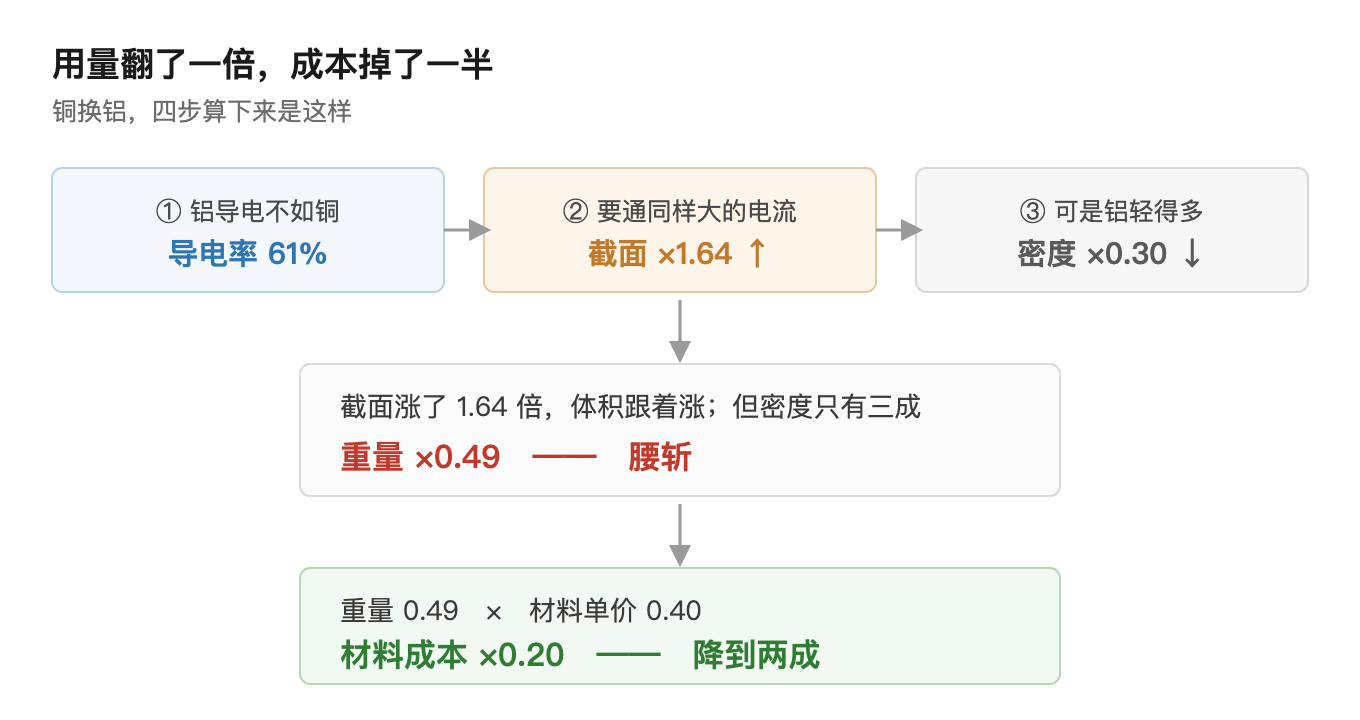
Aluminium's conductivity is only 61% of copper's. To carry the same current you need a bigger cross-section — 1.64 times. Bigger cross-section, bigger volume.
But aluminium is light. Copper's density is 8.96, aluminium's 2.70 — under a third.
So: cross-section up 1.64 times, so volume up; density under a third — weight becomes 0.49 times what it was. Halved.
Now multiply the unit price in:
Weight 0.49 × unit price 0.40 = material cost 0.20.
The material line falls to a fifth of what it was.
In one sentence: double the quantity, halve the cost — because the material went from copper, which is expensive by weight, to aluminium, which is light and cheap.
Now put it on a real part.
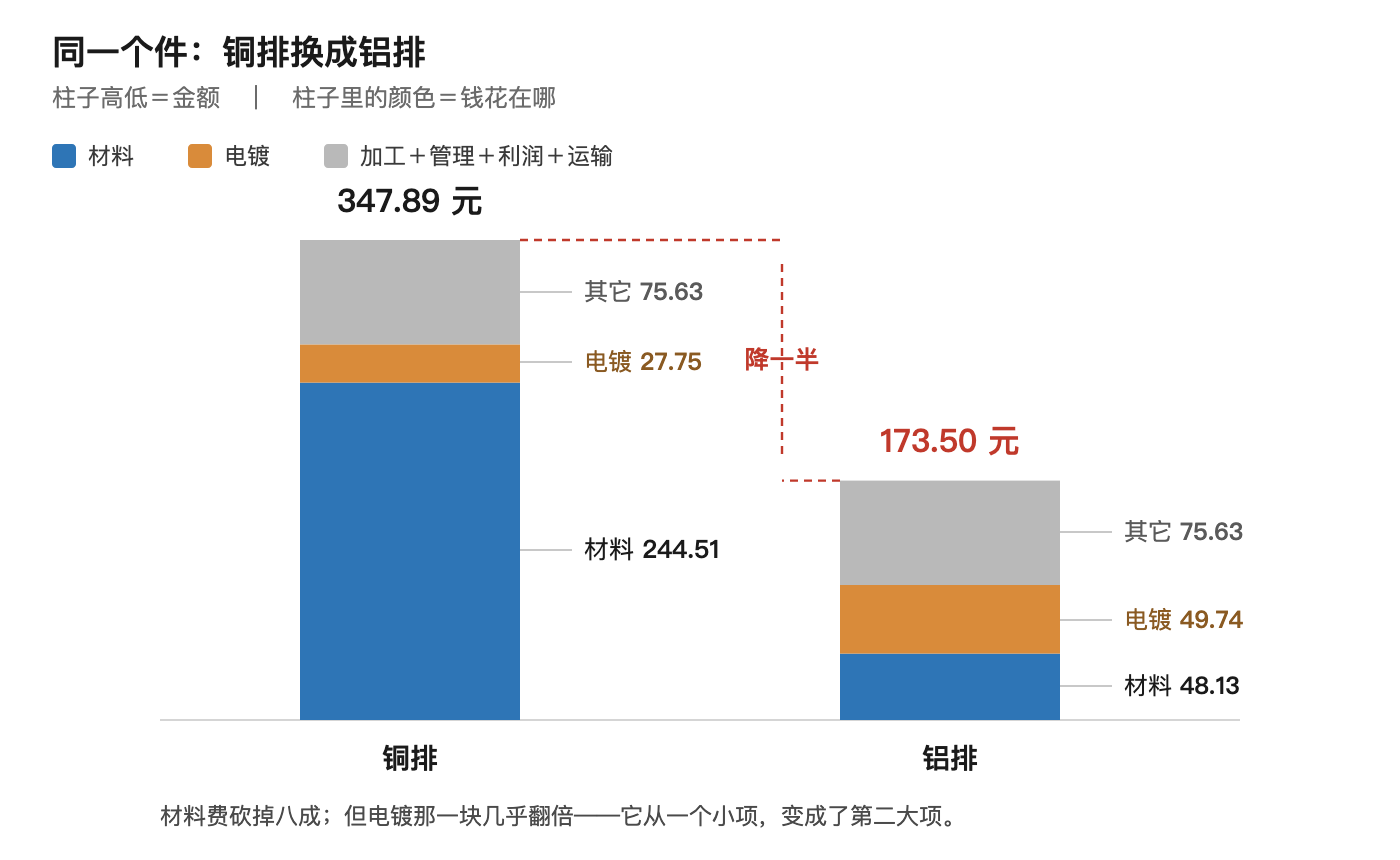
There is a copper bar in that quote: net weight 4.33 kg, unit price 347.89 yuan — of which material 244.51 yuan, plating 27.75 yuan, and the remaining 75.63 yuan.
The same part as an aluminium bar: material falls to around fifty yuan, and the whole part goes from 347.89 to 173.50 yuan.
Nearly half off.
I could have stopped there. But what comes next is worth more than everything before it.
Look at those two bars in the chart — the copper bar's money is seventy percent in material; the aluminium bar's money is in the plating.
The plating line has nearly doubled.
Why? Aluminium plating is itself more expensive: copper 2.50 yuan per square decimetre, aluminium 3.50 — forty percent more. And the plated area is bigger too. The cross-section went up 1.64 times, and the surface area goes up only by the square root of 1.64, about 1.28 times — the perimeter grows as well, but more slowly than the cross-section. Forty percent more expensive, times nearly thirty percent more area, and the plating cost nearly doubles.
Changing the material cut the material cost by eighty percent and doubled the plating cost.
Which means: the old reflexes — watch the material, watch the raw material price — are all useless on aluminium bar. The next cut has to be made in the plating.
Cost reduction is not a one-off move. Once you have changed it, the cost structure flips over, and the method has to change with it.
A few boundaries, or I will mislead people in this trade.
Changing material is not finished when the arithmetic on paper works. Conductivity looks good on paper; what actually blocks you is temperature rise — it has to go through heat testing. And an aluminium bar is not bare aluminium: it takes a nickel underlayer and then tin plating. Aluminium forms a non-conductive oxide film on its surface, so the plating is not a refinement, it is a functional necessity. Aluminium is also weaker and expands more with heat, so the joints need a larger contact area and a different fastening method.
Back to those 18 coffee machines.
That $3.36 was not created by the factory, and it was not negotiated out by purchasing.
It was decided when the drawings were drawn.
Haggling is arguing for a smaller number inside a number someone else has set.
Changing the design is moving the number itself.
The price is set by the supplier. The cost is set by the drawing.
And the drawing is within purchasing's reach.
Data sources: Ulrich and Pearson (1998), "Assessing the Importance of Design Through Product Archaeology", Management Science 44(3): 352–369. The 18 machines, the $7.37 average, the $5.92 minimum, the $9.28 maximum, the $3.36 spread, the six manufacturing-system scenarios, fasteners 2→32, parts 39→80, assembly 4.44→9.60 minutes, plastic 0.87→3.43 kg and sheet metal 0.22→1.33 kg all come from that paper. Copper and aluminium unit prices and shares come from a supplier quotation on a project I handled — material 56.67 / 22.50 yuan per kg, plating 2.50 / 3.50 yuan per square decimetre; material 70.9% / 33.3%, plating 8.1% / 43.8%.